
2.4 Fisheries and aquaculture as a special case
Fisheries and aquaculture represent a unique and particularly complex case within agricultural disaster impact assessment, facing distinct challenges that reflect their direct dependence on natural ecosystems, location in exposed and vulnerable coastal and riparian areas, and the inherent difficulty of monitoring and managing aquatic resources compared to terrestrial agricultural systems. These sectors provide food security, nutrition and livelihoods for some of the world’s most vulnerable, marginalized and disadvantaged communities, while making significant contributions to global food production and international trade.
The importance of fisheries and aquaculture for global food security cannot be overstated, with these sectors providing animal protein, essential micronutrients and livelihoods for hundreds of millions of people worldwide. As of 2022, 61.8 million people were engaged in primary fisheries and aquaculture production, mainly in small-scale operations that form the backbone of rural economies in many developing countries.88 Subsistence and secondary sector workers, along with their dependents, are part of the estimated 500 million people who rely on small-scale fisheries for their livelihoods. This total includes 53 million engaged in subsistence fishing, 45 percent of whom are women.82
The vulnerability of fisheries and aquaculture to disasters reflects their exposure to a wide range of hazards that can affect both the natural resource base and the human systems that depend on aquatic resources. Whether sudden-onset events, such as cyclones, tsunamis, and floods, or slow-onset threats, including sea-level rise, ocean acidification and shifts in sea surface temperature, disasters can impact fish stocks, destroy critical fisheries assets and infrastructure, and disrupt the livelihoods of millions who depend on fishing for their survival and economic well-being.
Small-scale fishers, especially those in low-income and fragile regions, face heightened risks from disasters, as they often lack access to early-warning systems and the ability to prepare, including the use of anticipatory action strategies, insurance schemes or social safety nets that could help them cope with disaster impacts. Beyond the immediate physical damages, losses and potential fatalities, disasters can have long-term consequences for food security and nutrition, environmental preservation, economic stability, social stability and community resilience, which may persist for years or decades.
Fisheries are vulnerable to single, simultaneous, compounding and cascading disaster impacts, each posing unique challenges that require different response strategies and recovery approaches. A single disaster, such as a tropical cyclone or flood, can immediately destroy fishing assets, disrupt fishing operations, damage infrastructure, degrade fish stocks, and disrupt livelihoods in ways that may take months or years to recover. Simultaneous events, such as consecutive cyclones, can compound damage, leaving little time for an effective and efficient response and recovery, while prolonging social and economic hardship for affected communities.
The intricate relationships between extreme climate events and fisheries are not fully understood. However, evidence suggests that rising variability in environmental factors, such as temperature, precipitation and wind patterns, influences fish growth, development, reproduction, mortality, distribution and migration, while also indirectly affecting the productivity, structure and composition of fish ecosystems. For example, the 2023 El Niño conditions resulted in a 50 percent reduction in the landings of the world’s largest single-species fishery, the Peruvian anchoveta, compared to 2022, impacting local livelihoods, national export revenues, and indirectly affecting sectors that depend on fishmeal and fish oil.82
While rapid restoration of fisheries activities can quickly provide nutritious foods and employment following disasters, making it an attractive intervention strategy, this reactive focus may miss opportunities for more proactive and cost-effective investments in prevention and preparedness that could reduce future disaster impacts. Compared to other sectors, the potential for rapid recovery in fisheries and aquaculture can provide immediate benefits for affected communities; however, long-term sustainability requires more comprehensive approaches that address underlying vulnerabilities and build resilience.
Assessment challenges in fisheries and aquaculture are particularly substantial due to several factors that distinguish this sector from crop and livestock agriculture, creating unique difficulties for systematic impact monitoring and evaluation. The sector is largely made up of small-scale fishers who are often not formally registered, and whose vessels and other assets are frequently undocumented in official records – resulting in limited baseline data for assessing post-disaster damages and losses. The frequent lack of comprehensive data on fish catches, fishing effort and economic value of fishing activities represents another significant challenge for quantifying disaster impacts using standard economic assessment methodologies. Many fishers and fish workers operate in the informal economy with limited documentation of their activities, assets or income, making it difficult to establish pre-disaster baselines or measure post-disaster changes using conventional assessment approaches.
Fishing communities are often located in remote coastal or riverine areas that become difficult or impossible to access when critical infrastructure is damaged or disasters disrupt communication systems. When post-disaster needs assessments (PDNAs) or rapid damage and needs assessments are undertaken, these areas may be too difficult or costly to reach for comprehensive evaluation, leading to the systematic underrepresentation of impacts on fisheries in disaster assessments.
The impacts of disasters on fisheries are complex and ecosystem-based, involving changes in fish behaviour, habitat degradation, water quality deterioration and ecological relationships that are not easily observed without specialized monitoring equipment and expertise. Unlike terrestrial agriculture, where crop damage is readily visible, fisheries impacts often involve underwater or offshore changes that require specialized assessment techniques and may not become apparent until fishing activities resume.
These assessment challenges extend to downstream segments of the fisheries value chain, including fish markets and cold chain systems that are critical for maintaining product quality and accessing profitable markets. Disasters frequently disrupt power supplies, transportation routes and storage infrastructure, resulting in immediate losses and the wastage of perishable fish products, while creating long-term disruptions in supply chain continuity that affect market access and profitability for extended periods.
As a result, post-disaster assessment and response in fisheries often overlook the sector, despite its significant importance for food security and livelihoods, resulting in limited support for recovery and rehabilitation that may leave affected communities struggling to restore their livelihoods. In this regard, the forestry and fisheries subsectors suffer from a lack of comprehensive information on their production, assets, activities and livelihoods, leading to frequent exclusion from post-disaster impact evaluations and needs assessments.89
To address these limitations, FAO has developed specialized guidelines and training programmes designed to enhance the capacity of governments and other stakeholders to conduct comprehensive assessments of the impacts of fisheries and aquaculture disasters.90 The Fisheries and Aquaculture Response to Emergency (FARE) training was delivered in four Caribbean SIDS, as well as Nicaragua, in 2024. In 2025, FARE was delivered in Belize, and further training is planned for Africa, Asia, and Latin America to expand the number of people trained in conducting assessments after disasters in the fisheries and aquaculture sector.
The training covers five main areas for assessment: fishing gear, vessels and engines; fisheries and aquaculture policy and management; landing sites, harbours and anchorages; aquaculture operations; post-harvest marketing and processing facilities; and environmental impacts. This comprehensive approach recognizes that disasters affect multiple components of the fisheries and aquaculture sector that require integrated assessment and response strategies. Key challenges identified through these training programmes include limited awareness and understanding of the fisheries and aquaculture sector among general disaster management personnel, the high costs associated with repairing or replacing fishing vessels and gear particularly for unregistered fishers or those lacking insurance, insufficient training across various institutional levels, and the absence of pre-established response plans to ensure timely and appropriate delivery of fishing equipment following disasters.
The integration of technological innovations, particularly drone technology combined with GIS remote sensing, blockchain, AI using ML algorithms, cloud computing, crowdsourcing and IoT sensors, offers promising solutions for addressing assessment challenges in fisheries while enhancing preparedness and response capabilities. Drones equipped with high-resolution cameras, sensors and technology can access remote areas and obtain near-real-time, high-resolution, spatially referenced aerial data of affected areas, enabling rapid assessment of damage to fisheries infrastructure and marine ecosystems.
These technologies can facilitate the mapping and monitoring of fish species and their habitats, such as mangroves and coral reefs, to assess biophysical degradation caused by disasters. This assessment creates detailed maps, three-dimensional models and orthomosaics of areas vulnerable to disasters, including fishing ports, cold storage facilities and processing plants. Additionally, drones can identify damaged or blocked supply routes, facilitate faster recovery of transportation networks, and assist in gathering data on affected fisheries and aquaculture communities.
However, technological interventions must be coupled with strengthened institutional capacities, enabling policy frameworks, and targeted investments to be effective in enhancing fisheries disaster risk management. Without complementary investments in human capital development, institutional strengthening and policy reform, technological solutions alone cannot address the fundamental vulnerabilities that make fisheries communities susceptible to disaster impacts.
The experience of fisheries and aquaculture highlights broader lessons for agricultural disaster risk management – including the importance of sector-specific approaches that recognize unique vulnerabilities and characteristics; the need for improved data collection and monitoring systems capable of capturing complex impacts; and the value of integrating technological innovations with institutional capacity building and policy reform to develop comprehensive solutions that address both immediate response needs and long-term resilience.
Without enhanced data collection and strategic action, the sector will remain under-prioritized in disaster response frameworks, limiting its potential to contribute to recovery, resilience and sustainable development in disaster-prone areas while leaving millions of people dependent on fisheries vulnerable to future disasters. The following section presents a novel attempt to quantify the impacts of marine heatwaves on global fisheries, as a first step towards developing data tools and methodologies that can provide evidence on the different loss trajectories in this subsector.
Quantifying the impacts of marine heatwaves
MHWs can be described as prolonged and discrete events of abnormally warm water, characterized by their persistence, intensity, rate of change and geographic coverage. From a quantitative perspective, MHWs are events that persist for a minimum of five days, characterized by temperatures exceeding the 90th percentile based on a historical reference period of 30 years.91 FIGURE 19 depicts the accumulated number of days under strong to extraordinary MHWs across the global ocean during the period 1982–2022, and separately for 2013–2022 to highlight the intensity of the most recent decade. The data are drawn from a database using the events classification developed by Hobday et al.92
FIGURE 19 Global distribution of accumulated strong to extraordinary MHW activity during the 1985–2022 (a) and 2013–2022 (b) periods
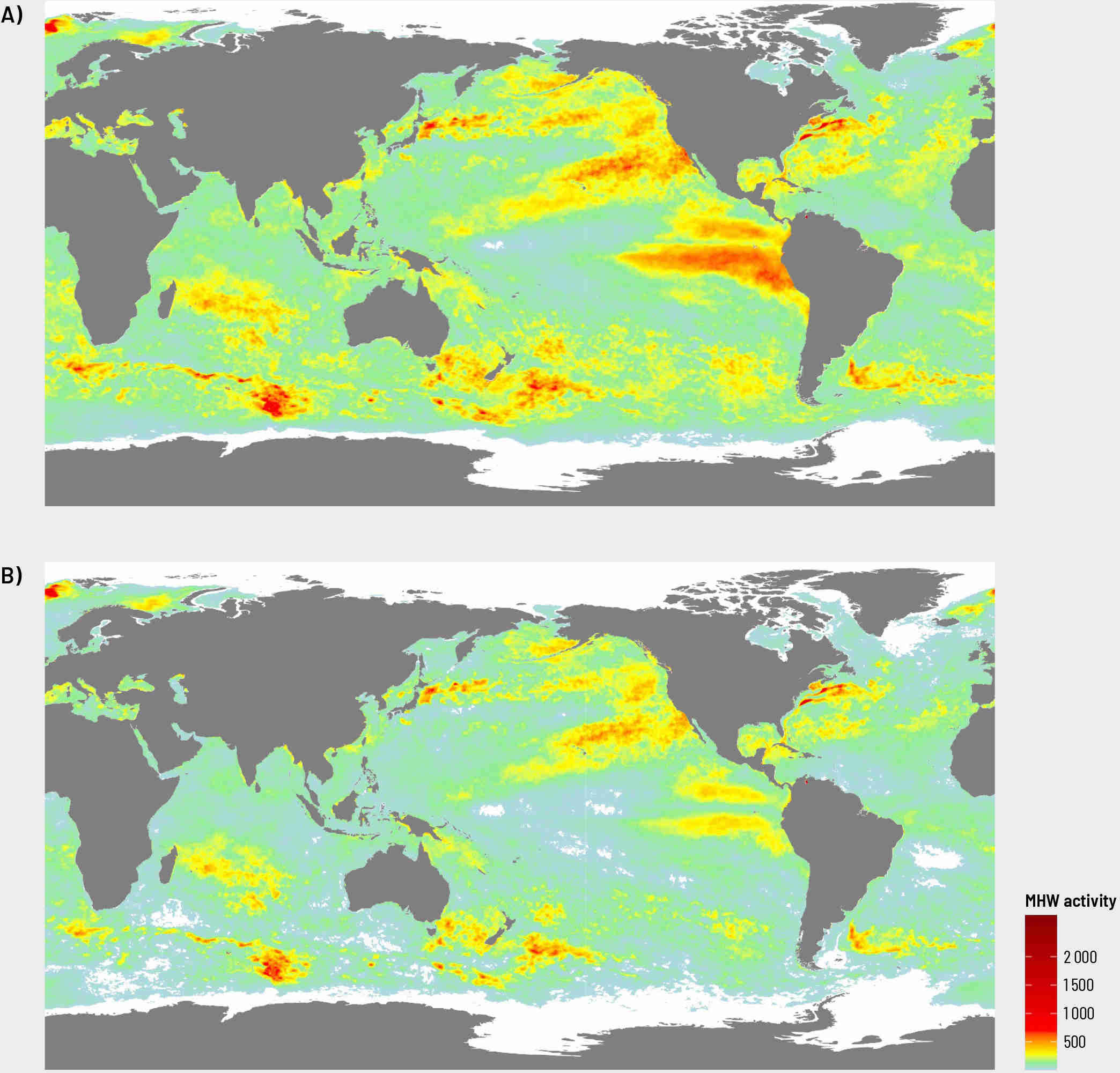
Source: Authors’ own elaboration based on data from Hobday, A., CSIRO, Oliver, E., Sen Gupta, A., Benthuysen, J., Burrows, M., Donat, M., Holbrook, N., Moore, P., Thomsen, M., Wernberg, T. & Smale, D. 2018. Categorizing and naming marine heatwaves. Oceanography (Washington, D.C.), 31(2). https://doi.org/10.5670/oceanog.2018.205. Cambridge, UK, Cambridge University Press and the wider literature.
Climate change is increasing the frequency and severity of large-scale MHWs.93 The rise in sea temperature has led to a significant increase of over 82 percent in the occurrence of MHWs across the world ocean.94,95 In a similar vein, the global count of days experiencing MHWs has risen during the 20th and early 21st centuries. On average, there has been a 50 percent increase in the number of MHWs days per year in the last three decades.96
MHWs have significant effects on ocean life. Mild events can sometimes enhance ocean chemistry and biology, but stronger ones may lead to a harmful buildup of organic matter and low oxygen levels. The response of ecosystems depends on the context.97 Strong MHWs can alter the distribution and abundance of species, causing mass mortality and ecosystem disruptions.98,99,100 Thermal stress can alter how fish grow, reproduce and behave, leading to population declines and shifts in marine communities throughout the water column.101,102,103
The impacts can thus include changes in fishing yields, deterioration in fish quality and shifts in fishing areas, as well as business-related impacts along the fish value chain, including higher expenses, less valuable alternative fisheries and decreased profitability. These can have significant implications on food security and livelihoods, especially in areas with limited nutritional options, such as low-income nations in Africa, Asia, Australasia and Central and South America.104
The following analysis of the global impacts of MHWs on marine fisheries was conducted at the spatial scale of exclusive economic zones, the highest resolution achievable based on FAO’s global fisheries statistics. For the empirical analysis of the links between MHWs activity and marine fisheries, the study focused on a spatial scale that combines the exclusive economic zones (EEZs) and FAO’s definition of Major Fishing Areas (MFAs). Because fisheries statistics are only available at the annual scale, the MHWs activity, which occurs at a timescale of days to months, was aggregated for each year to allow for comparison.
The investigation examined 2088 fisheries across 128 regions and 108 countries (production from countries fishing outside their EEZ was excluded), spanning a 37-year period from 1985 to 2022. The results demonstrate empirical evidence that MHWs resulted in an estimated production loss of over 5.6 million tonnes and impacted 15 percent of fisheries, predominantly concentrated in the last decade. The economic losses due to such production shortfalls amount to USD 6.6 billion, of which USD 3.9 billion occurred in the decade from 2013 to 2022. The results revealed no clear correlation between areas with higher MHW activity and the number or size of affected fisheries or losses. Instead, the proportion of affected fisheries remains relatively constant across regions, but areas with larger catches experienced a greater impact (FIGURE 20).
FIGURE 20 UPPER PANEL: AVERAGE MHWS INCIDENCE PER EZZ/MFA LOWER PANEL: IMPACTS ON FISHERIES PER MFA
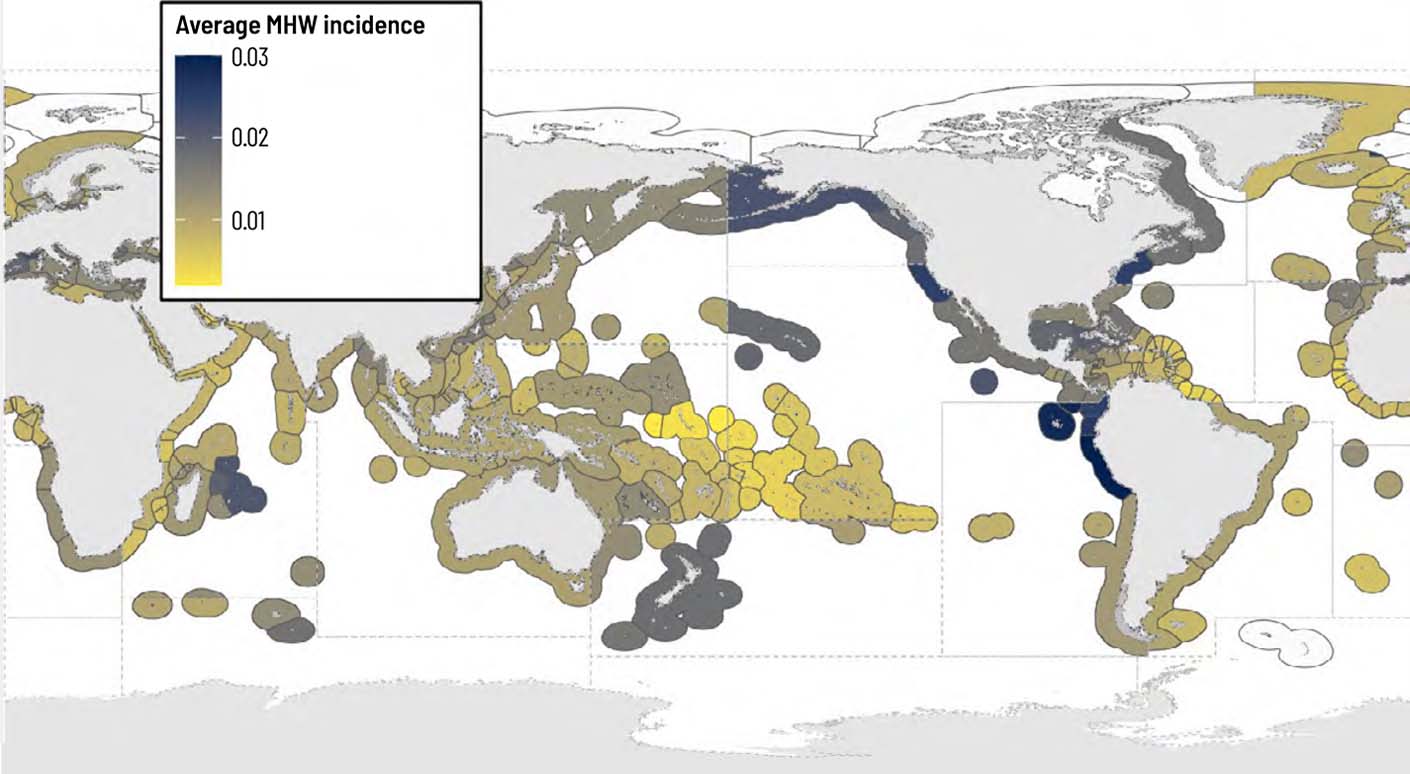


The most significant production losses were observed in the Northern Eastern Atlantic, followed by the Southern Eastern Pacific, with somewhat lesser losses in the Western Central and southern regions of the Northern Western Pacific, as well as the western coast of India. At the national level, Norway, Denmark, Japan and China account for over half of the global impact, with Peru – one of the world’s top fish producers – also significantly affected. Likewise, there is no clear pattern showing which species are more affected, as production and economic losses are more linked to the number of fisheries analysed than to species-specific traits. However, herrings, sardines and anchovies stand out, showing the most significant decline in production, despite ranking fourth in the number of cases examined. Over the past decade, MHW activity has increased, particularly in regions less influenced by El Niño–Southern Oscillation (ENSO) dynamics, such as the Northern Western Pacific, parts of the Western Central Atlantic, the Greenland Sea and areas of the Mediterranean.
Further research to assess the impacts of MHW on fish production is needed to improve the measurement of MHW activity, especially its spatial distribution and duration, and adopt a case-by-case approach to assess impacts, focusing on the physical mechanisms, fish population biology and regional climate signals for each MHW event. Enhanced spatial resolution, additional catch and pricing data and a better understanding of local physical processes will be crucial for this research.
Not all sensitive fisheries are the most vulnerable if they can adapt well. Early-warning systems and responsive management are crucial in mitigating risks associated with events like MHWs.105 Proactive decisions, such as adjusting quotas or closing areas, can help protect ecosystems and enable fisheries to respond in real-time. Effective adaptive management depends on leadership, regulations, market dynamics and operational costs. Long-term resilience strategies include diversifying target species, integrating climate risks into policies, fostering international cooperation and offering economic support or insurance for affected communities.
As detailed in Part 3 of this report, digital technologies transform risk management capabilities by offering unprecedented opportunities to enhance assessment methodologies and address longstanding measurement challenges. The integration of remote sensing, AI, mobile technologies, and advanced analytics offers potential solutions to many current limitations, while enabling more comprehensive, timely and cost-effective impact assessments. However, realizing this potential requires addressing fundamental gaps in conceptual frameworks, institutional capacity and data governance that currently limit the effectiveness of evaluations.


