
OPPORTUNITIES
MOVE FOOD
FORWARD
YOUTH
MOVE FOOD
FORWARD
ENGAGEMENT
MOVE FOOD
FORWARD
SOLUTIONS
MOVE FOOD
FORWARD

ENGAGEMENT
MOVES FOOD
FORWARD



©UNEP/TAUFANY ERIZ IN CIWIDEY, INDONESIA, A YOUNG FARMER PLANTS A TREE.
04 YOUTH ENGAGEMENT AND QUALITY OF WORK IN AGRIFOOD SYSTEMS

©UNEP/TAUFANY ERIZ IN CIWIDEY, INDONESIA, A YOUNG FARMER PLANTS A TREE.
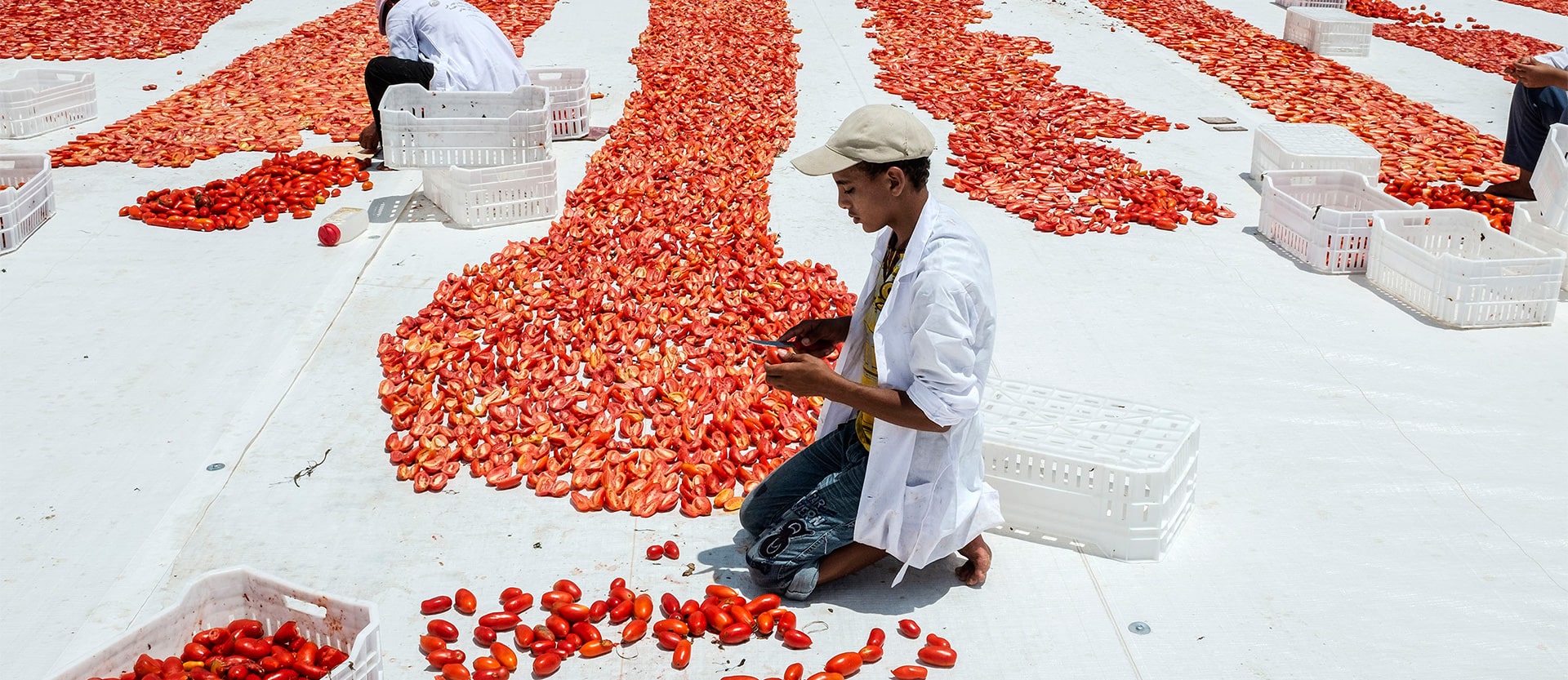

© FAO/HEBA KHAMIS IN BANGAR EL SOKOR, EGYPT, YOUNG WORKERS ARE ARRANGING THE TOMATOES TO DRY IN THE SUN.
KEY MESSAGES
- Agrifood systems are a key source of livelihoods for youth, especially in less formalized agrifood systems
- Globally, 44 percent of working youth and 38 percent of working adults were employed in agrifood systems in 2021.
- The share of working youth in agrifood systems employment declines as agrifood systems transition, ranging from 82 percent in protracted crisis to 23percent in industrial agrifood systems
- Since 2005, the global shares of working youth and adults have decreased by about 10 percentage points, driven mainly by decreases in agricultural employment. Across agrifood systems, employed youth and adults exit agriculture at a similar pace.
- Agrifood systems are key entry points to the labour market for younger youth aged 15–19. As agrifood systems transition, the entry point for younger youth shifts from agriculture to off-farm agrifood system employment, with this sector becoming increasingly more important for young women compared to young men.
- Youth, and especially younger youth, are less likely to have more than one economic activity outside agrifood systems. As they grow older, youth diversify and eventually exit agrifood systems employment.
- Intergenerational economic mobility outside of agriculture is more likely, particularly for young men, in contexts of higher agricultural labour productivity growth.
- Youth, and especially young women, engage in more precarious work in agrifood systems. Though declining with agrifood systems transition, a consistently greater share of young women are in vulnerable employment, particularly as contributing family workers, compared to their male counterparts.
- Young women are less likely to work full time, and across most agrifood systems young women are more likely than young men to remain outside the labour force and not in school.
- Young women allocate almost three times more time than young men to unpaid and domestic work.
INTRODUCTION
Youth represent an important share of the workforce in agrifood systems. In countries at earlier stages of transition, agrifood systems, and particularly agriculture, represent the largest shares of employment,1-4 with children and youth accounting for a significant share of the working population. Agrifood systems can also play a central role in youth job creation,5, 6 though the provision of decent employment remains a challenge.7, 8 As agrifood systems transition, and countries structurally transform, agrifood systems employment represents a decreasing share of total employment, and children and youth account for a smaller share of the working population (see Figure 2.5). The challenge increasingly becomes one of addressing labour shortages and generational renewal in agriculture,9, 11 which undermines future agrifood systems stability and rural revitalization12, 13 (see Spotlight 1.1)
Understanding the patterns of youth employment in agrifood systems, both in agriculture and off-farm, is critical to informing policies aimed at supporting productive and positive engagement of youth in the sector. This chapter sheds light on patterns of on- and off-farm agrifood systems employment (see Box 4.1 for a definition of employment) across agrifood systems over time and by age and gender cohorts. It looks not only at employment in terms of participation, but also in terms of time allocation, individual-level diversification and intergenerational mobility. It also discusses the quality of the jobs young men and women hold in agrifood systems, with specific attention to gender disparities. Finally, the chapter documents how the unpaid care and work burden on women undermines young women's employment in agrifood systems.
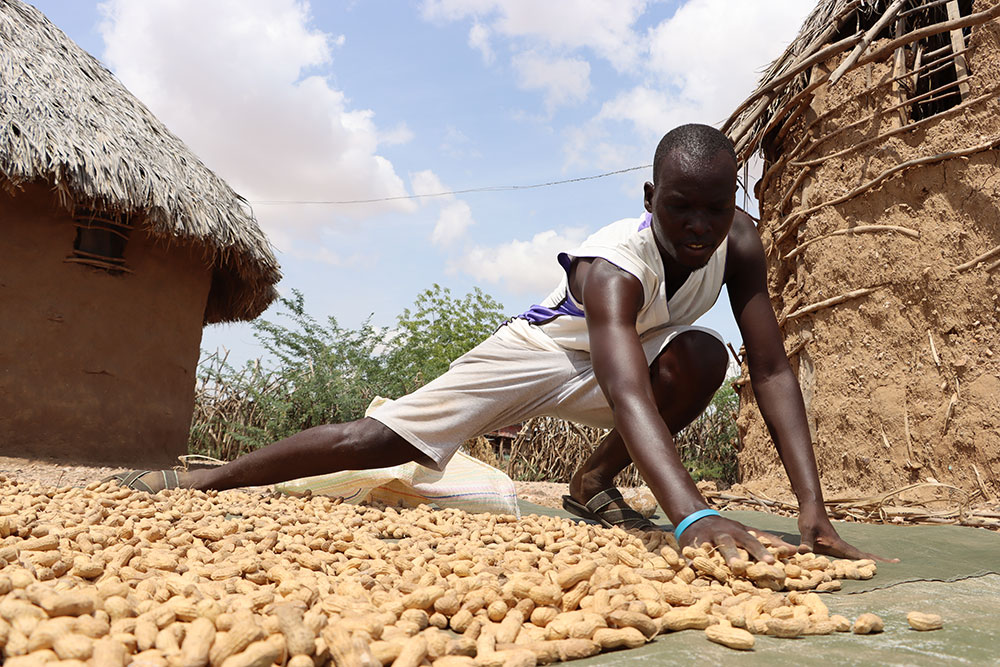
© FAO/JUDITH MULINGE IN TURKANA COUNTY, KENYA, ONESMUS ELAR DRIES GROUNDNUTS AT THE COMMUNITY STORE COMPOUND.
Box 4.1
YOUTH EMPLOYMENT AND WORK IN AGRIFOOD SYSTEMS: METHODOLOGICAL CONSIDERATIONS AND DATA
Official employment statistics define employment in terms of an employed individual’s main job in the last seven days, including only activities performed for pay or profit as per the distinction between work and employment adopted at the Nineteenth International Conference of Labour Statisticians (ICLS).i Yet, this definition does not adequately capture multiple forms of work and engagement in agrifood systems. A large share of individuals and households working in agrifood systems may be engaged in different activities producing goods mainly for their own consumption, activity which may be considered as work but not employment.ii, iii Individuals may also engage in multiple jobs and simultaneously work in agriculture or off-farm segments of agrifood systems activities.ii
These measurement considerations are critical when determining the importance of agrifood systems for youth in lowand middle-income countries. When they engage in additional jobs, a large share of youth is either involved in subsistence farming or in agrifood systems.iv To adequately capture the role played by youth in agrifood systems, as well as the importance of agrifood systems in youth’s livelihoods, this chapter considers both work and employment, to account for the various forms of work and engagement in agrifood systems.
Agrifood systems are defined following a specific categorization of industry codes (ISIC), distinguishing between agriculture, food processing and services, and manufacture of non-food agricultural products.ii A detailed definition and categorization of ISIC codes can be found in Table A2.1 of Appendix 2. Some analyses also differentiate between different types of agrifood systems, following recent typologiesv,vi (see Box 1.1).
This chapter also uses multiple sources of data. First, the chapter uses age-disaggregated global data on the share and number of youth and adults in agriculture and off-farm agrifood systems. The modelling approach draws on that of Davis et al.ii and employs unpublished ILO estimates based on ILO modelled estimates (November 2023)vii on the share of youth among all agricultural workers. More details on the model used can be found in Appendix 2.
Second, the chapter uses estimates derived from survey data on the share and number of youth and adults in agriculture and off-farm agrifood systems, based on ad hoc tabulations provided by ILOSTAT.viii These data cover up to 77 countries and are, whenever applicable, disaggregated by gender and detailed age cohorts
Third, some analyses in this chapter build on micro-level data produced by Davis et al.ii These data include data from up to 18 low– and lower-middle income countries on individual engagement in agrifood systems. These data have also been merged with geospatial data to analyse patterns of youth engagement along the rural opportunity space framework presented in Chapter 2 (see Spotlight 4.1).
Notes: Refers to the Notes section for full citations.
YOUTH EMPLOYMENT IN AGRIFOOD SYSTEMS DECREASES WITH DEVELOPMENT
YOUTH EMPLOYMENT IN AGRIFOOD SYSTEMS
In 2021, approximately 44 percent of employed youth and 38 percent of employed adults were working in agrifood systems, compared with 54percent of youth and 47 percent of adults in 2005 (Figure 4.1). This reduction in agrifood systems employment is explained primarily by the decline in agricultural employment in both age cohorts over this period.

GLOBALLY, 44 PERCENT OF WORKING YOUTH WERE EMPLOYED IN AGRIFOOD SYSTEMS IN 2021.
©FAO/TANG CHHIN SOTHY KAMPONG CHHNANG, CAMBODIA, 17-YEAR-OLD CHHUM KIMSEAK WRITES ON THE BOARD DURING CLASS AT HER SCHOOL IN KOUK BANTEAY COMMUNE, HIGHLIGHTING THE ROLE OF EDUCATION IN EMPOWERING RURAL YOUTH.
Figure 4.1
EMPLOYMENT IN AGRIFOOD SYSTEMS REMAINS IMPORTANT FOR YOUTH
Share of agrifood systems employment in total employment in 2005 and 2021, by age cohort

Note: Shares for youth do not amount to 100 percent due to rounding. Graph based on data from 136 countries: Sub-Saharan Africa: Burundi, Benin, Burkina Faso, Botswana, Cape Verde, Comoros, Côte d’Ivoire, Ethiopia, Gambia, Ghana, Guinea, Guinea-Bissau, Kenya, Lesotho, Madagascar, Malawi, Mali, Mauritania, Mauritius, Mozambique, Namibia, Niger, Nigeria, Rwanda, Senegal, South Africa, Swaziland, United Republic of Tanzania, Togo, Uganda, Zambia, Zimbabwe. Southern Asia: Afghanistan, Bangladesh, India, Iran (Islamic Republic of), Nepal, Pakistan, Sri Lanka. Southeastern Asia: Cambodia, Indonesia, Lao People’s Democratic, Republic, Malaysia, Myanmar, Philippines, Thailand, Timor-Leste, Viet Nam. Eastern Asia: China, Japan, Korea (Republic of), Mongolia.Central Asia: Kazakhstan, Kyrgyzstan, Tajikistan, Uzbekistan. Western Asia: Azerbaijan, Cyprus, Georgia, Iraq, Israel, Jordan, Lebanon, Oman, Palestine, Saudi Arabia, Türkiye, United Arab Emirates. Northern Africa: Algeria, Egypt, Morocco, Tunisia. Latin America and the Caribbean: Argentina, Bahamas, Belize, Bolivia (Plurinational State of), Brazil, Chile, Colombia, Costa Rica, Dominican Republic, Ecuador, El Salvador, Guatemala, Guyana, Haiti, Honduras, Jamaica, Mexico, Nicaragua, Panama, Paraguay, Peru, Suriname, Trinidad and Tobago, Uruguay. Oceania: Australia, Fiji, New Zealand. Europe and Northern America: Albania, Austria, Belgium, Bosnia and Herzegovina, Bulgaria, Croatia, Czechia, Denmark, Germany, Estonia, Finland, France, Greece, Hungary, Iceland, Ireland, Italy, Latvia, Lithuania, Luxembourg, Malta, Moldova (Republic of), Netherlands (Kingdom of the), North Macedonia, Norway, Poland, Portugal, Romania, Russian Federation, Slovakia, Slovenia, Spain, Sweden, Switzerland, Ukraine, United Kingdom of Great Britain and Northern Ireland, United States of America.
Source: Author’s own elaboration, using ILO estimates based on ILO modelled estimates, November 2023. These estimates provide the share of youth among all agricultural workers. The share and number of youth in agriculture and off-farm agrifood systems employment were modelled, adapting an approach used by Davis et al. 1 and detailed in Appendix 2.
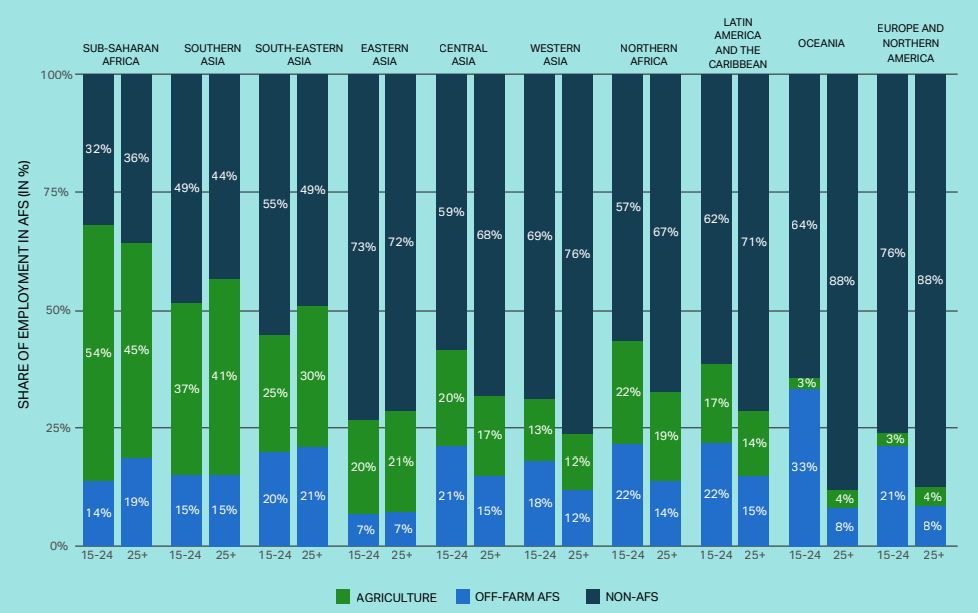
Looking first at youth employment in agrifood systems by region (Figure 4.2), the largest shares are found in sub-Saharan Africa and South Asia, with 68 percent and 52 percent, respectively. Most of these youth are working in agriculture.5 In more developed countries, including from Southeastern Asia and Latin America and the Caribbean, while relatively larger shares of employed youth work in agrifood systems (45 percent and 39 percent, respectively), a greater portion of youth work off-farm in agrifood systems. In higher-income countries, with lower shares of rural youth in their populations, such as Europe and Northern America, less than a quarter of employed youth work in agrifood systems, mostly offfarm. In Oceania and Europe and Northern America, the share of youth employed in agrifood systems is more than double that of adults.
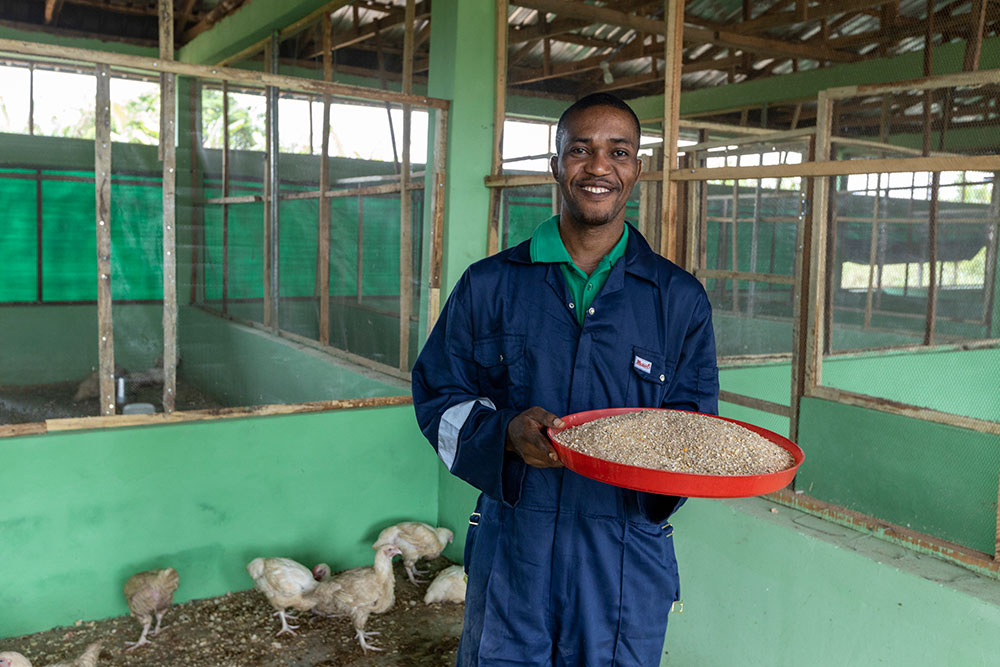
©IFAD/ANDREW ESIEBO IN OVIA NORTH, EDO STATE, NIGERIA, AIGBOKHAE OSIFO EFOSAS STANDS PROUDLY WITH HIS CHICKEN FEED IN THE POULTRY PENS, WHICH TRANSFORMED HIM FROM AN UNEMPLOYED YOUTH INTO A THRIVING ENTREPRENEUR.
Figure 4.2
AGRIFOOD SYSTEMS ARE A KEY SOURCE OF EMPLOYMENT FOR YOUTH IN AFRICA AND SOUTHERN ASIA
Share of agrifood systems employment in total employment in 2021, by age cohort and region
Note: Shares for youth do not amount to 100 percent due to rounding. Graph based on data from 136 countries: Sub-Saharan Africa: Burundi, Benin, Burkina Faso, Botswana, Cape Verde, Comoros, Côte d’Ivoire, Ethiopia, Gambia, Ghana, Guinea, Guinea-Bissau, Kenya, Lesotho, Madagascar, Malawi, Mali, Mauritania, Mauritius, Mozambique, Namibia, Niger, Nigeria, Rwanda, Senegal, South Africa, Swaziland, United Republic of Tanzania, Togo, Uganda, Zambia, Zimbabwe. Southern Asia: Afghanistan, Bangladesh, India, Iran (Islamic Republic of), Nepal, Pakistan, Sri Lanka. Southeastern Asia: Cambodia, Indonesia, Lao People’s Democratic, Republic, Malaysia, Myanmar, Philippines, Thailand, Timor-Leste, Viet Nam. Eastern Asia: China, Japan, Korea (Republic of), Mongolia.Central Asia: Kazakhstan, Kyrgyzstan, Tajikistan, Uzbekistan. Western Asia: Azerbaijan, Cyprus, Georgia, Iraq, Israel, Jordan, Lebanon, Oman, Palestine, Saudi Arabia, Türkiye, United Arab Emirates. Northern Africa: Algeria, Egypt, Morocco, Tunisia. Latin America and the Caribbean: Argentina, Bahamas, Belize, Bolivia (Plurinational State of), Brazil, Chile, Colombia, Costa Rica, Dominican Republic, Ecuador, El Salvador, Guatemala, Guyana, Haiti, Honduras, Jamaica, Mexico, Nicaragua, Panama, Paraguay, Peru, Suriname, Trinidad and Tobago, Uruguay. Oceania: Australia, Fiji, New Zealand. Europe and Northern America: Albania, Austria, Belgium, Bosnia and Herzegovina, Bulgaria, Croatia, Czechia, Denmark, Germany, Estonia, Finland, France, Greece, Hungary, Iceland, Ireland, Italy, Latvia, Lithuania, Luxembourg, Malta, Moldova (Republic of), Netherlands (Kingdom of the), North Macedonia, Norway, Poland, Portugal, Romania, Russian Federation, Slovakia, Slovenia, Spain, Sweden, Switzerland, Ukraine, United Kingdom of Great Britain and Northern Ireland, United States of America.
Source: Author’s own elaboration, using ILO estimates based on ILO modelled estimates, November 2023. These estimates provide the share of youth among all agricultural workers. The share and number of youth in agriculture and off-farm agrifood systems employment were modelled, adapting an approach used by Davis et al. 1 and detailed in Appendix 2.
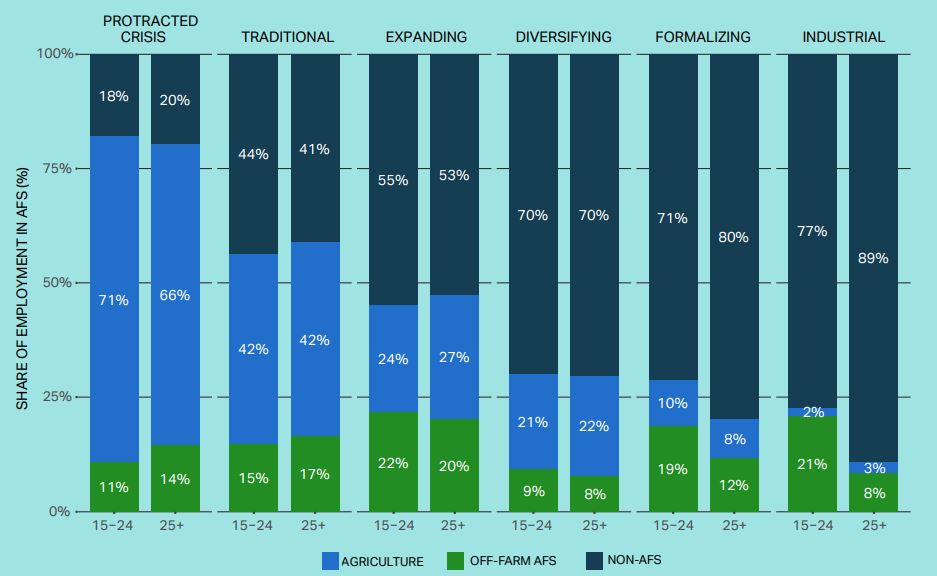
Youth employment in agrifood systems decreases as agrifood systems transition (Figure 4.3). The share of agrifood systems employment for youth ranges from 82 percent in protracted crisis agrifood systems to 57percent in traditional agrifood systems, and 46percent in expanding agrifood systems. The importance of agrifood systems for youth employment, as well for adults, continues to decline, with 30 percent of employed youth in diversifying agrifood systems, 29 percent in formalizing agrifood systems, and 23 percent in industrial agrifood systems.
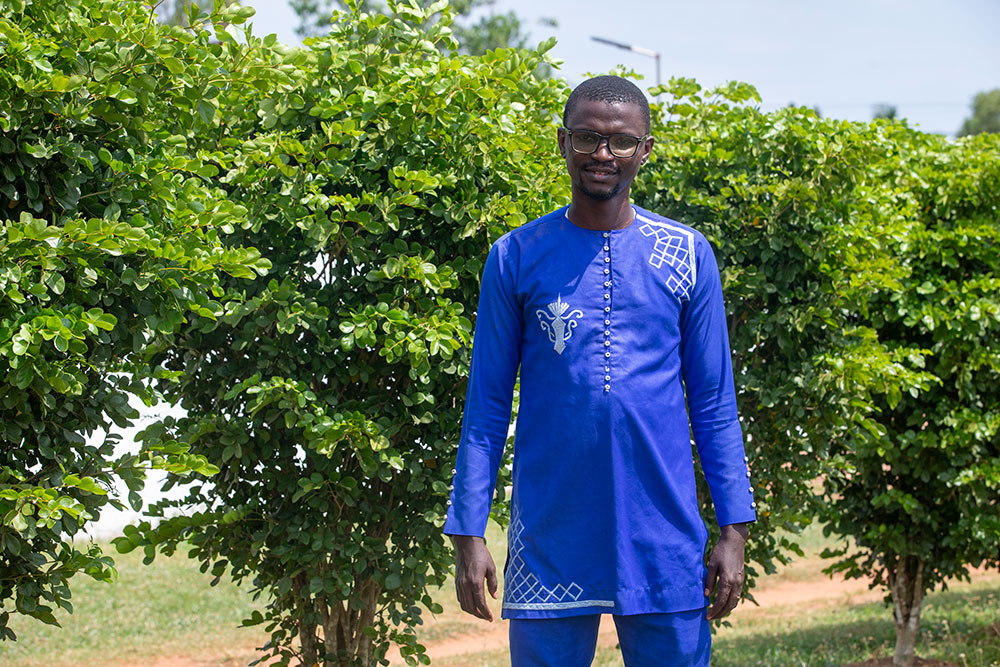
©FAO/GIULIO NAPOLITANO IN AKASSATO, BENIN, DANIEL NARCISE SAVI, A YOUNG AGRIBUSINESS PROFESSIONAL, STANDS AT THE ALITECH FACTORY, REPRESENTING A NEW GENERATION DRIVING PRIVATE SECTOR INNOVATION IN AGRICULTURE.
Figure 4.3
AGRIFOOD SYSTEMS ARE A CRITICAL SOURCE OF EMPLOYMENT FOR YOUTH IN LESS FORMALIZED AGRIFOOD SYSTEM CATEGORIES
Share of agrifood systems employment in total employment in 2021, by age cohort and type of agrifood system
Note: Graph based on data from 136 countries: Protracted crisis: Afghanistan, Burundi, Ethiopia, Haiti, Mali, Mauritania, Niger, Palestine, Zimbabwe. Traditional: Bangladesh, Benin, Burkina Faso, Cambodia, Comoros, Côte d’Ivoire, Ghana, Guinea, Guinea-Bissau, India, Kenya, Lao People’s Democratic Republic, Lesotho, Madagascar, Malawi, Mozambique, Myanmar, Nepal, Nigeria, Pakistan, Rwanda, Senegal, Tajikistan, United Republic of Tanzania, Timor-Leste, Togo, Uganda, Zambia. Expanding: Azerbaijan, Bolivia (Plurinational State of), Botswana, Cape Verde, Egypt, El Salvador, Gambia, Georgia, Guatemala, Honduras, Indonesia, Iraq, Kyrgyzstan, Morocco, Namibia, Nicaragua, Paraguay, Peru, Philippines, Sri Lanka, Swaziland, Thailand, Uzbekistan, Viet Nam. Diversifying: Algeria, Belize, Bosnia and Herzegovina, China, Ecuador, Fiji, Guyana, Iran (Islamic Republic of), Jamaica, Kazakhstan, Lebanon, Mauritius, Moldova (Republic of), Mexico, Panama, Poland, Romania, Suriname, Trinidad and Tobago, Tunisia, Ukraine, South Africa. Formalizing: Albania, Argentina, Brazil, Bulgaria, Chile, Colombia, Costa Rica, Croatia, Cyprus, Dominican Republic, Hungary, Ireland, Jordan, Latvia, Lithuania, Malaysia, Mongolia, North Macedonia, Oman, Portugal, Russian Federation, Saudi Arabia, Slovakia, Slovenia, Türkiye, United Arab Emirates. Industrial: Australia, Austria, Bahamas, Belgium, Czechia, Denmark, Estonia, Finland, France, Germany, Greece, Iceland, Israel, Italy, Japan, Korea (Republic of), Luxembourg, Malta, Netherlands (Kingdom of the), New Zealand, Norway, Spain, Sweden, Switzerland, Uruguay, United Kingdom of Great Britain and Northern Ireland, United States of America.
Source: Author’s own elaboration, using ILO estimates based on ILO modelled estimates, November 2023. These estimates provide the share of youth among all agricultural workers. The share and number of youth in agriculture and off-farm agrifood systems employment were modelled, adapting an approach used by Davis et al. 1 and detailed in Appendix 2.
Youth and adult employment in agrifood systems follow similar patterns as agrifood systems transition. This process is driven mainly by adults and youth moving out of agriculture as countries structurally transform (Figure 4.4). In all types of agrifood systems the share of youth and adults in agricultural employment out of all youth and adults in employment and in the labour force declined over time, with similar trajectories between youth and adults.

©FAO/GIULIO NAPOLITANO IN ATHIEME, BENIN, YOUNG COOPERATIVE LEADER ADELE GOGOE SERVES AS SECRETARY OF THE LOCAL MAIZE PRODUCERS’ UNION, EXEMPLIFYING YOUTH LEADERSHIP IN STRENGTHENING COMMUNITY-BASED AGRIFOOD SYSTEMS.
Figure 4.4
YOUTH AND ADULTS IN EMPLOYMENT AND THE LABOUR FORCE EXIT AGRICULTURE AT A SIMILAR PACE
Share of adults and youth employment and labour force in agriculture between 2005 and 2021, by agrifood system type

Note:Graph based on data from 136 countries: Protracted crisis: Afghanistan, Burundi, Ethiopia, Haiti, Mali, Mauritania, Niger, Palestine, Zimbabwe. Traditional: Bangladesh, Benin, Burkina Faso, Cambodia, Comoros, Côte d’Ivoire, Ghana, Guinea, Guinea-Bissau, India, Kenya, Lao People’s Democratic Republic, Lesotho, Madagascar, Malawi, Mozambique, Myanmar, Nepal, Nigeria, Pakistan, Rwanda, Senegal, Tajikistan, United Republic of Tanzania, Timor-Leste, Togo, Uganda, Zambia. Expanding: Azerbaijan, Bolivia (Plurinational State of), Botswana, Cape Verde, Egypt, El Salvador, Gambia, Georgia, Guatemala, Honduras, Indonesia, Iraq, Kyrgyzstan, Morocco, Namibia, Nicaragua, Paraguay, Peru, Philippines, Sri Lanka, Swaziland, Thailand, Uzbekistan, Viet Nam. Diversifying: Algeria, Belize, Bosnia and Herzegovina, China, Ecuador, Fiji, Guyana, Iran (Islamic Republic of), Jamaica, Kazakhstan, Lebanon, Mauritius, Moldova (Republic of), Mexico, Panama, Poland, Romania, Suriname, Trinidad and Tobago, Tunisia, Ukraine, South Africa. Formalizing: Albania, Argentina, Brazil, Bulgaria, Chile, Colombia, Costa Rica, Croatia, Cyprus, Dominican Republic, Hungary, Ireland, Jordan, Latvia, Lithuania, Malaysia, Mongolia, North Macedonia, Oman, Portugal, Russian Federation, Saudi Arabia, Slovakia, Slovenia, Türkiye, United Arab Emirates. Industrial: Australia, Austria, Bahamas, Belgium, Czechia, Denmark, Estonia, Finland, France, Germany, Greece, Iceland, Israel, Italy, Japan, Korea (Republic of), Luxembourg, Malta, Netherlands (Kingdom of the), New Zealand, Norway, Spain, Sweden, Switzerland, Uruguay, United Kingdom of Great Britain and Northern Ireland, United States of America
Source: Author’s own elaboration, using ILO estimates based on ILO modelled estimates, November 2023. These estimates provide the share of youth among all agricultural workers. The share and number of youth in agriculture and off-farm agrifood systems employment were modelled, adapting an approach used by Davis et al. 1 and detailed in Appendix 2.s
Multiple factors explain this exit from agriculture. The structural transformation process, characterized by increases in labour productivity and increased income and demand in non-food products and services, typically results in a shifting of the workforce into more stable and better paying jobs in the secondary and tertiary sectors.5, 14 As can be seen in (Figure 4.4), countries with less formalized agrifood systems are at an earlier stage of this process but have experienced more rapid declines in agricultural employment, affecting both youth and adults. Along with these economic shifts, multiple factors have played a critical role in shaping labour markets and youth engagement in agriculture, such as negative perceptions of work in agriculture,15-17 limited access to land,18-21 and other inputs as well as increased educational attainment, all of which have reshaped youth aspirations and capacity to pursue jobs in the off-farm sector associated with better income and opportunities15 (see (Spotlight 1.1) and Chapter 3).
While the share of agriculture and broader agrifood systems employment declines as agrifood systems transition, this employment remains critical for large numbers of youth and adults, especially in less formalized agrifood systems (Figure 4.5). Globally, while the number of adults working in agrifood systems has remained stable between 2005 and 2021, the number of youth employed in the sector, both in agriculture and off-farm segments of agrifood systems, has declined during the same period. This decline is driven mostly by large decreases in countries with diversifying agrifood systems. For example, China has experienced a decrease in the number of workers in agriculture.22-23 While the number of young workers in agrifood systems has declined over time in traditional agrifood systems, this number has remained more stable in other types of agrifood systems. In countries with large youth populations, especially with traditional agrifood systems, agrifood systems still provide employment opportunities to a large number of youth entering labour markets.

©FAO/LUIS TATO IN KIAMBU COUNTY, KENYA, RUTH WANJIRU MBURU AND GRACE WANJIRA KANGHETE FEED THEIR KIENYEJI CHICKENS ON A YOUTH-RUN FARM, SHOWCASING HOW AGRIBUSINESS TRAINING IS CREATING LOCAL OPPORTUNITIES AND ALTERNATIVES TO MIGRATION FOR RURAL YOUTH.
Figure 4.5
AGRIFOOD SYSTEMS EMPLOYMENT DECLINES BUT REMAINS CRITICAL FOR MANY WORKERS IN LESS FORMALIZED AGRIFOOD SYSTEMS
Number of workers in agrifood systems between 2005 and 2021, by sector and agrifood system type

Note: Graph based on data from 131 countries: Protracted crisis: Afghanistan, Burundi, Ethiopia, Haiti, Mali, Mauritania, Palestine, Zimbabwe. Traditional: Benin, Burkina Faso, Bangladesh, Cambodia, Comoros, Côte d’Ivoire, Ghana, Guinea-Bissau, India, Kenya, Lao People’s Democratic Republic, Lesotho, Madagascar, Malawi, Mozambique, Myanmar, Nepal, Nigeria, Pakistan, Senegal, United Republic of Tanzania, Timor-Leste, Togo, Uganda, Zambia. Expanding: Azerbaijan, Bolivia (Plurinational State of), Botswana, Cape Verde, Egypt, El Salvador, Gambia, Georgia, Guatemala, Honduras, Indonesia, Iraq, Kyrgyzstan, Morocco, Namibia, Nicaragua, Paraguay, Peru, Philippines, Swaziland, Thailand, Uzbekistan, Viet Nam. Diversifying: Algeria, Belize, Bosnia and Herzegovina, China, Ecuador, Fiji, Guyana, Iran (Islamic Republic of), Jamaica, Kazakhstan, Lebanon, Mauritius, Moldova (Republic of), Mexico, Panama, Poland, Romania, Suriname, Trinidad and Tobago, Tunisia, Ukraine, South Africa. Formalizing: Albania, Argentina, Brazil, Bulgaria, Chile, Colombia, Costa Rica, Croatia, Cyprus, Dominican Republic, Hungary, Ireland, Jordan, Latvia, Lithuania, Malaysia, Mongolia, North Macedonia, Oman, Portugal, Russian Federation, Saudi Arabia, Slovakia, Slovenia, Türkiye, United Arab Emirates. Industrial: Australia, Austria, Bahamas, Belgium, Czechia, Denmark, Estonia, Finland, France, Germany, Greece, Iceland, Israel, Italy, Japan, Korea (Republic of), Luxembourg, Malta, Netherlands (Kingdom of the), New Zealand, Norway, Spain, Sweden, Switzerland, Uruguay, United Kingdom of Great Britain and Northern Ireland, United States of America.
Source: Author’s own elaboration, using ILO estimates based on ILO modelled estimates, November 2023. These estimates provide the share of youth among all agricultural workers. The share and number of youth in agriculture and off-farm agrifood systems employment were modelled, adapting an approach used by Davis et al. 1 and detailed in Appendix 2.
YOUTH SHARES OUT OF ALL AGRIFOOD SYSTEMS WORKERS ARE LINKED TO AGRIFOOD SYSTEMS TRANSITION
Globally, youth constitute 15 percent of all agrifood systems workers, although this share varies as agrifood systems transition (Figure 4.6). In countries with protracted crises, about a quarter of agrifood systems workers and almost 30 percent of agricultural workers are aged 15–24. The share of youth among all agrifood systems workers declines as agrifood systems transition, reaching 9 percent in emerging agrifood systems. In modernizing and industrial agrifood systems, the share of agrifood systems workers categorized as youth increases to 15 percent and 20 percent, respectively, driven primarily by increasing shares of youth among off-farm agrifood systems workers. In industrial agrifood systems, youth account for only 7 percent of agriculture workers, reflecting the aging of the agriculture sector. 9, 13, 24
YOUTH REPRESENT 15 PERCENT OF ALL AGRIFOOD SYSTEMS WORKERS IN THE WORLD.

©FAO/SAIKAT MOJUMDE IN BRAHMANBARIA, BANGLADESH, A YOUNG MEMBER OF A COMMUNITYBASED ORGANIZATION TRANSPORTS HARVESTED FISH TO A NEARBY MARKET AFTER FOUR MONTHS OF FLOATING CAGE AQUACULTURE, DEMONSTRATING YOUTH-LED INNOVATION IN SUSTAINABLE FISH FARMING.
Figure 4.6
ABOUT 15 PERCENT OF AGRIFOOD SYSTEMS WORKERS ARE YOUTH, ALTHOUGH SHARES DIFFER BY AGRIFOOD SYSTEM TYPE
Share of youth out of all agrifood systems workers in 2021, by agrifood system type and sector

Note: Graph based on data from 136 countries: Protracted crisis: Afghanistan, Burundi, Ethiopia, Haiti, Mali, Mauritania, Niger, Palestine, Zimbabwe. Traditional: Bangladesh, Benin, Burkina Faso, Cambodia, Comoros, Côte d’Ivoire, Ghana, Guinea, Guinea-Bissau, India, Kenya, Lao People’s Democratic Republic, Lesotho, Madagascar, Malawi, Mozambique, Myanmar, Nepal, Nigeria, Pakistan, Rwanda, Senegal, Tajikistan, United Republic of Tanzania, Timor-Leste, Togo, Uganda, Zambia. Expanding: Azerbaijan, Bolivia (Plurinational State of), Botswana, Cape Verde, Egypt, El Salvador, Gambia, Georgia, Guatemala, Honduras, Indonesia, Iraq, Kyrgyzstan, Morocco, Namibia, Nicaragua, Paraguay, Peru, Philippines, Sri Lanka, Swaziland, Thailand, Uzbekistan, Viet Nam. Diversifying: Algeria, Belize, Bosnia and Herzegovina, China, Ecuador, Fiji, Guyana, Iran (Islamic Republic of), Jamaica, Kazakhstan, Lebanon, Mauritius, Moldova (Republic of), Mexico, Panama, Poland, Romania, Suriname, Trinidad and Tobago, Tunisia, Ukraine, South Africa. Formalizing: Albania, Argentina, Brazil, Bulgaria, Chile, Colombia, Costa Rica, Croatia, Cyprus, Dominican Republic, Hungary, Ireland, Jordan, Latvia, Lithuania, Malaysia, Mongolia, North Macedonia, Oman, Portugal, Russian Federation, Saudi Arabia, Slovakia, Slovenia, Türkiye, United Arab Emirates. Industrial: Australia, Austria, Bahamas, Belgium, Czechia, Denmark, Estonia, Finland, France, Germany, Greece, Iceland, Israel, Italy, Japan, Korea (Republic of), Luxembourg, Malta, Netherlands (Kingdom of the), New Zealand, Norway, Spain, Sweden, Switzerland, Uruguay, United Kingdom of Great Britain and Northern Ireland, United States of America
Source: Author’s own elaboration, using ILO estimates based on ILO modelled estimates, November 2023. These estimates provide the share of youth among all agricultural workers. The share and number of youth in agriculture and off-farm agrifood systems employment were modelled, adapting an approach used by Davis et al. 1 and detailed in Appendix 2.
Figure 4.7 provides the age distribution of workers in agrifood systems by more granular age cohorts and gender using non-modelled data. Among men, agrifood systems in protracted crisis have the most youthful structure, with the largest share of workers found in the 15–24 age category, followed by those aged 25–34 and 35–44. Across agrifood systems transition, except for industrial agrifood systems, young men constitute a larger share of agrifood systems workers, reflecting lower levels of female labour force participation. In all other age cohorts, male workers consistently represent larger shares of agrifood systems workers than their female counterparts.
Within agrifood system types, countries have substantial heterogeneity in the share of youth among all agrifood systems workers. In all countries with protracted crises in the sample (Ethiopia, Mali, Palestine, South Sudan and Zimbabwe) and several countries with traditional agrifood systems (Madagascar, Pakistan, Uganda and Zambia), many of which have large youth populations (see Figure 2.4 in Chapter 2), youth represent about one-quarter of all agrifood systems workers. Among diversifying agrifood systems, nearly 20 percent of agrifood systems workers are aged 15–24 in Ecuador, Mexico and Panama, while in expanding agrifood systems, more than 20 percent of agrifood systems workers are aged 15–24 in Angola, the Gambia, Guatemala, Honduras, Iraq, Kyrgyzstan and Peru. In industrial agrifood systems, while youth represent a minor share of agrifood systems workers in Japan (5 percent) or Greece (6 percent), they account for 29 percent and 36 percent of all agrifood systems workers in Israel and Australia, respectively.
While the contribution of youth to agrifood systems employment decreases as agrifood systems transition, youth remain over-represented in the sector. With the exception of young men in traditional agrifood systems, the shares of youth among workers in agrifood systems is larger than their shares in total employment in almost all settings, making agrifood systems more reliant on youth than other sectors.
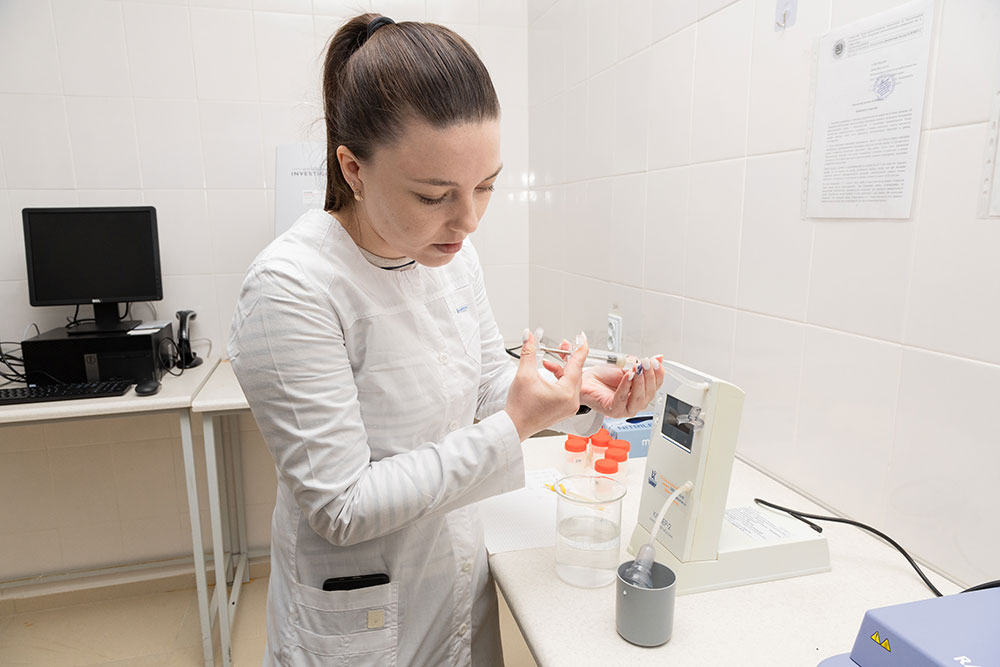
©FAO/NASTYA PALAGUTINA IN ASTANA, KAZAKHSTAN, A YOUNG LABORATORY WORKER PREPARES RAW MILK SAMPLES FOR TESTING, CONTRIBUTING TO FOOD SAFETY AND QUALITY ASSURANCE IN THE DAIRY VALUE CHAIN.
Figure 4.7
YOUTH ARE OVERREPRESENTED IN ALMOST ALL AGRIFOOD SYSTEMS TYPES
Share of different age cohorts out of all agrifood systems workers and total employment in 2021, by agrifood system type and gender

Note: Graph based on data from 72 countries: Protracted crisis: Afghanistan, Ethiopia, Mali, Palestine, Sudan, Zimbabwe. Traditional: Bangladesh, Burkina Faso, Cambodia, Comoros, Guinea-Bissau, India, Lao People’s Democratic Republic, Madagascar, Nigeria, Pakistan, Papua New Guinea, Rwanda, Senegal, Timor-Leste, Togo, Uganda, Zambia. Diversifying: Armenia, Bosnia and Herzegovina, Ecuador, Iran (Islamic Republic of), Mauritius, Mexico, Panama, South Africa, Tunisia. Expanding: Angola, Bolivia (Plurinational State of), Botswana, Egypt, El Salvador, Eswatini, Gambia, Georgia, Guatemala, Honduras, Iraq, Kyrgyzstan, Peru, Samoa, Sri Lanka, Thailand, Viet Nam, Formalizing: Albania, Argentina, Belarus, Costa Rica, Cyprus, Dominican Republic, Jordan, Mongolia, North Macedonia, Portugal, Saudi Arabia, Slovakia, Türkiye, United Arab Emirates. Industrial: Australia, Austria, Czechia, France, Greece, Israel, Japan, Switzerland, United Kingdom of Great Britain and Northern Ireland.
Source: Author’s own elaboration based on ILO Harmonized Microdata, https://ilostat.ilo.org/
The decline of youth’s share in agrifood systems is linked to a drop in the share of youth among all agricultural workers. While there are no major changes within agrifood system types, which have maintained overall similar demographic structures among agricultural workers, different regions have seen a substantial decline in the shares of youth among all agricultural workers (see Figure A5.2 in Appendix 5). Sub regions in Asia have experienced the sharpest declines, whereas in subSaharan Africa, the decline has been more gradual, with youth representation decreasing by about 2 percentage points over the last two decades. As both youth and adults leave agriculture at a similar pace, including proportionately to their levels of development,5, 25 agriculture relies more extensively on adult workers as agrifood systems transition.
While overall trends show a decrease in the role of youth in agriculture, the share of youth among agriculture workers increased in some countries, such as Angola (from 21 percent to 29 percent), Uganda (from 31 percent to 36 percent) and Ecuador (from 19 percent to 22 percent) (Table A5.1 in Appendix 5). This may be due to the increased participation of youth in agriculture in low-income and lower-middle-income countries after the onset of the COVID-19 pandemic, as well as the success of agricultural interventions in promoting youth employment, such as land titling, farmer school programmes and other programmes that aim to shape youth’s perceptions of agricultural employment.26, 28 In many industrialized agrifood systems, the share of young workers in the sector also increased (e.g. from 6 percent to 9 percent in France), which could be linked to clearer farm succession plans,29 the presence of young farmers in these agrifood systems26, 30 or highly specialized agricultural activities.
THE DECLINE IN YOUTH'S SHARE IN AGRIFOOD SYSTEMS IS LINKED TO A DECLINING SHARE OF YOUTH IN AGRICULTURE.
MANY YOUTH LEAVE AGRICULTURE FOR SCHOOL
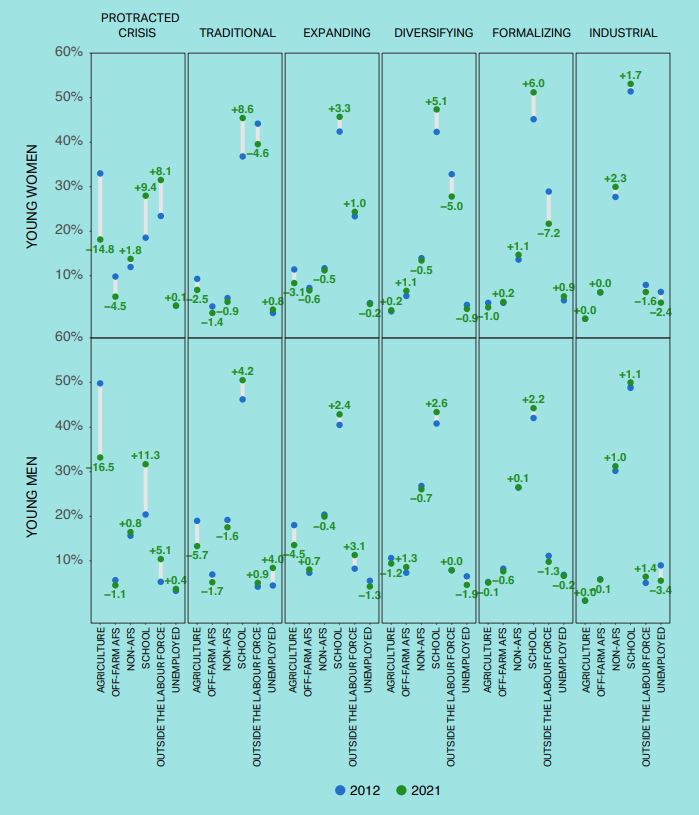
Different patterns emerge regarding young people’s paths when they exit agriculture (Figure 4.8). In countries with less formalized agrifood systems, the drop in the share of working-age youth employed in agriculture between 2012 and 2021 coincided with an increase in the share of youth in school. For example, in countries with protracted crisis agrifood systems, the share of young working-age women and men declined by 17 and 15 percentage points, respectively, while the share of those in school increased by 11 and 9 percentage points. A similar trend is observed in countries with traditional and expanding agrifood systems. These trends reflect the progress made in educational attainment in these countries, especially as they catch up with more formalized agrifood systems (see Chapter 3).
Young women are also catching up with young men. Across agrifood system types, greater shares of young women were engaged in school in 2021 than in 2012. In fact, a greater share of young women were in school in 2021 compared to young men across expanding, diversifying, formalizing and industrial agrifood systems.
Young women, however, remain much more likely to be outside of the labour force and not in school than young men across all agrifood system types, except industrial agrifood systems (see Chapter 3). The high proportion of young women outside of the labour force who are not in school may be linked to gender norms that constrain women’s choices and impose expectations that they engage in unpaid work.31, 32 This makes them more vulnerable to being pushed out of the labour force during crises.32
Figure 4.8
DECLINE IN THE SHARE OF YOUTH EMPLOYED IN AGRICULTURE COINCIDES WITH AN INCREASE IN SCHOOL PARTICIPATION
Status of working-age youth in 2012 and 2021, by agrifood system type
Note: The graph shows the distribution of working-age population between 2012 (or the nearest year within a three-year band) and 2021, disaggregated by age and gender cohorts. The changes between 2012 and 2021 do not always add up to 100 due to rounding. Graph based on data from 37 countries: Protracted crisis: Afghanistan, Ethiopia, Palestine, Zimbabwe. Traditional: Comoros, Cambodia, India, Timor-Leste, Uganda. Expanding: Angola, Bolivia, Egypt, El Salvador, Kyrgyzstan, Peru, Thailand, Viet Nam. Diversifying: Armenia, Bosnia and Herzegovina, Ecuador, Iran (Islamic Republic of), Mauritius, Mexico. Formalizing: Albania, Argentina, Dominican Republic, Mongolia, North Macedonia, Portugal, Slovakia, Türkiye. Industrial: Austria, Czechia, Greece, France, Switzerland, United Kingdom of Great Britain and Northern Ireland.
Source: Author’s own elaboration. The shares of youth employed in agriculture, off-farm agrifood systems and outside agrifood systems are based on ILO Harmonized Microdata, https://ilostat.ilo.org/ The shares of youth in school, outside the labour force and unemployed were calculated based on annual data from the ILOSTAT and YouthSTATS databases.
AGRIFOOD SYSTEMS REMAIN KEY FOR YOUTH
AGRIFOOD SYSTEMS AS A CRITICAL ENTRY POINT FOR YOUTH EMPLOYMENT
While youth employment in agrifood systems declines with development and agrifood systems transition, agrifood systems remain a critical entry point for youth (Figure 4.9).33, 34 The youngest category of men (15–19 years of age) relies more on agrifood systems employment than youth aged 20–24 across all levels of agrifood systems transition. This is also true for young women, except in the case of traditional agrifood systems. For example, in protracted crisis agrifood systems, 76 percent and 66 percent of men and women, respectively, aged 15–19 rely on agrifood systems employment, compared with 66 percent and 63 percent of men and women, respectively, aged 20–24. The percentages decrease moving from protracted crisis to industrial food systems, where 25 percent of men and 29 percent of women aged 15–19 are in agrifood systems employment, compared to 13 percent of men and 12 percent of women aged 20–24.
In the first three types of agrifood system transition, younger youth rely extensively on agriculture for their livelihoods, with engagement in own farming being the most direct entry point for those living in farm-owning households,33, 34 an involvement that in some cases started much earlier in childhood.35 This is particularly true for youth aged 15–17, who have reached the legal minimum age for employment and rely extensively on agrifood systems.36
At the same time, the share of youth aged 15–19 and 20–24 employed in off-farm agrifood systems employment increases, particularly for young women, in expanding agrifood systems (31 percent of young women aged 15–19 and 24 percent of young women aged 20–24, compared to 18 percent of young men aged 15–19 and 19 percent of young men aged 20–24, respectively), diversifying agrifood systems (39 percent versus 21 percent and 24 percent versus 18 percent, respectively) and industrial agrifood systems (27 percent of young women aged 15–19 versus 23 percent of young men aged 15–19).
Variation in agrifood systems employment by age cohort is “C”-shaped across all types of agrifood system transition, except for women in protracted crisis agrifood systems. Following initial high levels, as individuals age, smaller shares are employed in agrifood systems employment until the 35–44 age cohort, at which point both women and men return to agrifood systems employment. As agrifood systems transition, the youngest cohort increasingly works on off-farm agrifood systems employment, while the oldest cohort focuses on agriculture.
AGRIFOOD SYSTEMS, ESPECIALLY AGRICULTURE, ARE KEY SOURCES OF LIVELIHOODS FOR YOUNGER YOUTH (15-19).
Figure 4.9
AGRIFOOD SYSTEMS ARE A MAJOR ENTRY POINT FOR YOUNGER YOUTH, BUT YOUNG MEN EXIT AGRIFOOD SYSTEMS FASTER THAN YOUNG WOMEN
Share of workers in agrifood systems between 2005 and 2021, by sector and agrifood system type

Note: The shares of total agrifood system employment do not always add up to the sum of the shares of agricultural and off-farm agrifood system employment due to rounding. Graph based on data from 77 countries: Protracted crisis: Afghanistan, Ethiopia, Mali, Sudan, West Bank and the Gaza Strip, Zimbabwe. Traditional: Bangladesh, Burkina Faso, Cambodia, Comoros, Guinea-Bissau, India, Lao People’s Democratic Republic, Madagascar, Nigeria, Pakistan, Papua New Guinea, Rwanda, Senegal, Timor-Leste, Togo, Uganda, Zambia. Expanding: Angola, Bolivia, Botswana, Egypt, El Salvador, Eswatini, Gambia, Georgia, Guatemala, Honduras, Iraq, Kyrgyz Republic, Peru, Samoa, Sri Lanka, Thailand, Viet Nam. Diversifying: Armenia, Bosnia and Herzegovina, Ecuador, Iran (Islamic Republic of), Mauritius, Mexico, Panama, South Africa, Trinidad and Tobago, Tunisia. Formalizing: Albania, Argentina, Belarus, Costa Rica, Cyprus, Dominican Republic, Jordan, Mongolia, North Macedonia, Portugal, Saudi Arabia, Slovak Republic, Türkiye, United Arab Emirates. Industrial: Australia, Austria, Czechia, France, Greece, Israel, Japan, Switzerland, United Kingdom of Great Britain and Northern Ireland.
Source: Author’s own elaboration based on ILO Harmonized Microdata, https://ilostat.ilo.org/
Agrifood systems remain a larger source of livelihoods for young women than young men across all agrifood system types. In protracted crisis and traditional agrifood systems, the youngest men are exiting the sector faster than young women (aged 15–19). Lower shares of working men aged 25–64 compared to women from the same age cohort work in protracted crisis, traditional, and expanding agrifood systems. In agrifood systems further along the transition process, that is diversifying, formalizing, and industrial agrifood systems, similar or slightly higher shares of men aged 25–64 are employed in agrifood systems, compared to their female counterparts. In protracted crisis and traditional agrifood systems, women’s employment is at similarly (high) levels across age cohorts, stressing the importance of agrifood systems employment for women throughout their life cycle. A similar pattern is observed in spaces with severe challenges and limited economic opportunities, where women’s livelihoods rely more extensively on agrifood systems (see Spotlight 4.1).
IMPORTANCE OF OFF-FARM AGRIFOOD SYSTEMS
Off-farm agrifood systems can provide employment opportunities that may be more accessible to youth.33 These can be found on different segments of agrifood systems and involve firms of different sizes. As agrifood systems transition, more job opportunities are created in off-farm segments and the “hidden middle” of agrifood systems, in particular in small- and medium-sized enterprises (SMEs),7-37-38 who dominate the midstream of agrifood systems,37-39 often supplied by smallscale farmers.38 A review by Berdegué et al. 7 stresses that SMEs in agrifood systems represent important sources of employment for youth, who may also be attracted by the use of modern and new technologies in the sector.7-42-43 However, in earlier stages of agrifood systems transition, many of these SMEs are informal and exhibit low productivity.44. 47 Evidence from Zimbabwe, for example, suggests that while many youth work in SMEs, such work often takes place in precarious circumstances.48
Globally, the share of youth among off-farm agrifood systems workers is 15 percent (Figure 4.6). Countries with protracted crisis and industrial agrifood systems display the highest shares of youth out of all off-farm agrifood systems workers (21 percent and 22 percent, respectively). In traditional agrifood systems, 16 percent of all off-farm agrifood systems workers are aged 15–24, but these shares decline slightly as agrifood systems transition, with 14 percent and 11 percent of youth among off-farm agrifood systems workers in informal and emerging agrifood systems, respectively. In modernizing agrifood systems, the share of youth among all off-farm agrifood systems workers increases to 16 percent.
In countries with protracted crisis and traditional agrifood systems, the share of youth among all offfarm agrifood systems workers is lower than the share of youth among all agriculture workers or out of all workers. Several factors may contribute to this, including limited access to financial resources, which hinders youth from pursuing education, training or entrepreneurial opportunities,28-34-49 including in the off-farm sector. Increased educational attainment in more developed economies often leads to youth studying longer, but without corresponding access to relevant skills for off-farm jobs. Skills mismatch also plays a critical role (see Chapter 3), with discrepancies between the types and levels of education young people receive and the demands of the off-farm agrifood systems market. Inequitable access to quality education further exacerbates this issue, limiting opportunities for youth in rural areas or lower-income communities to transition successfully into the offfarm sector.50, 51 In transitioning and industrial agrifood systems, youth shares among all workers are higher in off-farm agrifood systems employment, compared to agriculture and total employment.
Generally, off-farm agrifood system employment is a more critical source of livelihoods for women (Figure 4.9).32, 52 Young women, particularly those aged 15–19, are more likely than young men to be employed in off-farm agrifood systems, except in contexts of protracted crisis (Figure 4.9). As agrifood systems transition, the significance of off-farm agrifood systems employment grows more rapidly for young women than for young men. For example, among women aged 15–19, its share increases from 10 percent in protracted crisis agrifood systems to 27 percent in industrial systems, while the share for young men increases from 7 percent in protracted crisis agrifood systems to 23 percent in industrial systems. In general, as youth get older, they tend to transition out of off-farm agrifood systems, with young women in general exiting the sector at higher rates than young men as they approach young adulthood, especially in agrifood systems further along the transition process (Figure 4.9).
Off-farm agrifood systems also present greater livelihood opportunities for urban youth, compared to their rural peers and their adult counterparts in urban areas (Figure 4.10). Unsurprisingly, employment outside agrifood systems dominates in urban areas, in line with recent evidence.33 Yet, non-negligible shares of employed urban youth rely on off-farm agrifood systems employment. In protracted crisis and traditional agrifood systems, approximately one in five employed youth in urban areas work in off-farm agrifood systems. The importance of off-farm agrifood systems in urban areas increases as agrifood systems transition. In expanding and diversifying agrifood systems, 22 percent of young employed urban men and 34 percent and 28 percent of young employed urban women, respectively, work in off-farm agrifood systems. This situation could reflect the fact that new job opportunities generated off-farm by the transition of agrifood systems, especially in SMEs, coupled with urbanization,37, 40 can benefit urban youth who are more likely to engage in non-farm employment.7, 33 In formalizing and industrial agrifood systems, slightly lower shares of urban youth engage in off-farm agrifood systems employment, although they rely more on such employment than adults.
(Figure 4.10) also shows a sharper decline in agricultural employment in rural areas as agrifood systems transition, although it also decreases in urban areas. In rural areas, off-farm agrifood systems employment is more important for young women than young men, across agrifood system types, compared to urban areas, except in industrial agrifood systems, where the shares are similar (21 percent and 22 percent, respectively). Many of the jobs created in SMEs that are located predominantly in urban areas remain linked to agriculture and primary production,7 with urban centres connected to their surrounding areas.53, 54 Yet, beyond the rural-urban dichotomy, understanding how agrifood system employment opportunities evolve along the rural-urban continuum is critical, taking into consideration the unequal services and opportunities available across different areas54 (see Spotlight 4.1).
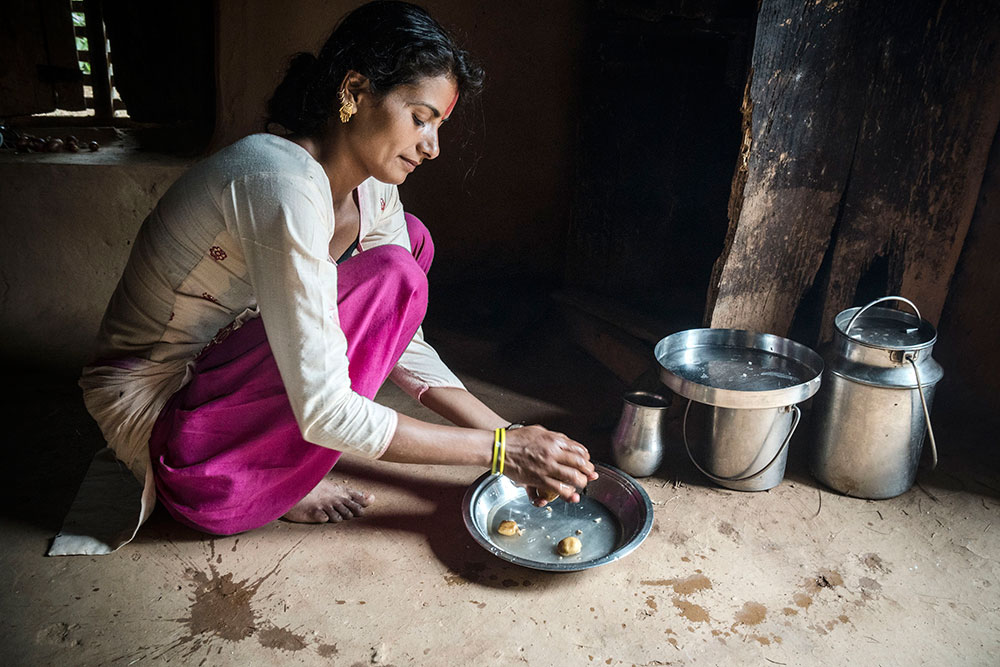
©FAO/CHRIS STEELE-PERKINS/ MAGNUM PH IN THE VILLAGE OF NARAPANI, NEPAL, RIPA THAPA PREPARES THE EVENING MEAL AT HOME WHILE HER HUSBAND WORKS ABROAD. CLIMATE-SMART AGRICULTURE INITIATIVES HELP YOUNG FAMILIES LIKE HERS ADAPT TO CLIMATE CHANGE AND REDUCE THE NEED FOR MIGRATION.
Figure 4.10
OFF-FARM AGRIFOOD SYSTEMS ARE MORE IMPORTANT FOR YOUTH IN URBAN AREAS IN LESS CONSOLIDATED AGRIFOOD SYSTEMS
Share of employment in agrifood systems, by gender, age cohort and location (2021)

Note: Graph based on data from 47 countries: Protracted crisis: Ethiopia, Mali, Sudan, Zimbabwe. Traditional: Burkina Faso, Cambodia, Guinea-Bissau, India, Lao People’s Democratic Republic, Madagascar, Nigeria, Pakistan, Rwanda, Senegal, Timor-Leste, Togo, Uganda, Zambia. Expanding: Bolivia (Plurinational State of), Egypt, El Salvador, Gambia, Georgia, Guatemala, Honduras, Iraq, Peru, Thailand, Viet Nam. Diversifying: Bosnia and Herzegovina, Ecuador, Mexico, Panama, Tunisia, South Africa. Formalizing: Belarus, Costa Rica, Dominican Republic, Jordan, Mongolia. Industrial: Australia, Austria, Czechia, France, Greece, Switzerland.
Source: Author’s own elaboration based on ILO Harmonized Microdata, https://ilostat.ilo.org/
Youth participation varies among the various sectors that make up off-farm agrifood systems, ranging from 10.2 percent in transportation to 17 percent in food processing and services (Table 4.1). These shares increase for young adults aged 25–34, reaching approximately 25 percent across all categories, and surpassing 50 percent for older adults. There are also significant gender gaps in off-farm agrifood employment. Among male and female youth these gender gaps are most pronounced in trade and transportation – two of the more lucrative off-farm activities in agrifood systems,32 where young women represent 4.8 percent and 0.7 percent of all workers, respectively, compared to 9.9 percent and 9.5 percent of young men. Across all age cohorts, men consistently have higher participation rates than women, and young women’s share is always lower than their young adult and adult counterparts. Reduced participation of young women may be due to stricter social norms55 and reduced access to capital and resources for this specific group56 – essential factors for jobs that may require higher mobility and interactions with outsiders.32
FEW YOUNG WOMEN ARE ENGAGED IN PROFITABLE OFF-FARM ACTIVITIES.
Table 4.1
YOUTH ARE A SMALLER PORTION OF WORKERS ACROSS AGRIFOOD SYSTEMS SUB-SECTORS

Note: Based on data from 52 countries: Protracted crisis: Afghanistan, Ethiopia, Palestine, Zimbabwe. Traditional: Cambodia, Comoros, India, Pakistan, R wanda, Timor-Leste, Uganda, Z ambia. Expanding: Angola, Bolivia (Plurinational State of ), Botswana, Egypt, El Salvador, Eswatini, Georgia, Iraq, Kyrgyzstan, Peru, Sri Lanka, Thailand, Viet Nam. Diversifying: Armenia, Bosnia and Herzegovina, Ecuador, Iran (Islamic Republic of ), Mauritius, Mexico, South Africa, Trinidad and Tobago. Formalizing: Albania, Argentina, Belarus, Costa Rica, Cyprus, Dominican Republic, Jordan, Mongolia, North Macedonia, Portugal, Saudi Arabia, Slovakia, Türkiye, United Arab Emirates. Industrial: Australia, Austria, Czechia, Finland, Greece, Israel, Japan, Switzerland, United Kingdom of Great Britain and Northern Ireland. The list of ISIC codes in each category can be found in Table A2.1, Appendix 2.
Source: Author’s own elaboration based on ILO Harmonized Microdata, https://ilostat.ilo.org/
SPECIALIZATION AND DIVERSIFICATION
Diversification is a key feature of urban and rural livelihoods in low- and lower- and middle-income countries, with households holding diverse portfolios consisting of multiple income sources and activities across sectors and occupations.57-61 Households diversify as a result of push and pull factors including market failure, risk management, better job opportunities and/or complementary activities.57, 62-64 Such diversification can happen at the household level with different household members allocating their time to different activities,58, 65 c In this analysis, the number of jobs is computed from information collected from employment modules in the questionnaires and does not account for time spent in own farming from the agriculture module. Diversification of activities may thus be underestimated, especially for individuals in rural areas, who are more likely to combine own farming with off-farm activities.57, 61, 62 or at the individual level with one individual holding more than one job within or across sectors.1, 33, 66-68
Youth are less likely than adults to hold multiple jobs or diversify their portfolio of activities (Figure 4.11).c Across a sample of 16 low- and lower-middle-income countries, young men and women are more likely than their adult counterparts to hold one job only, in agriculture, in offfarm agrifood systems employment or outside agrifood systems. Even at the maximum level of diversification, at around age 50 for both men and women, only 25 percent of individuals have more than one job.
Figure 4.11
YOUTH ARE MORE LIKELY THAN ADULTS TO HAVE ONLY ONE JOB OR TO WORK IN THE SAME SECTOR
Share of individuals with one job or more, by gender, age and sector

Note: Data from 16 countries: Benin, Bolivia (Plurinational State of), Burkina Faso, Côte d’Ivoire, Georgia, Guatemala, Guinea Bissau, Mali, Mozambique, Niger, Nigeria, Peru, Senegal, Sierra Leone, Togo, Uganda). Unweighted means. More information on how the number of jobs were computed available in Davis et al.1
Source: Author’s own elaboration, using data shared by Davis et al. 1 and building on data from the Rural Livelihoods Information System (RuLIS).71 The list of surveys used for this graph is available in Appendix 3.
Youth, and especially younger youth, rely more extensively on agrifood systems than adults, regardless of how many jobs they hold (Figure 4.11). Among individuals with only one job, larger shares of youth are engaged in agrifood systems, in particular in agriculture, than adults. In line with the results presented earlier in this chapter, larger shares of young women are engaged in off-farm agrifood systems employment and larger shares of young men in employment outside agrifood systems. Even when young people hold more than one job, all of them are likely to be in agriculture. The majority of youth having multiple jobs either work solely in agrifood systems (either in agriculture, off-farm agrifood systems or a combination thereof) or combine agrifood systems employment with work outside agrifood systems. In other words, most youth diversifying their portfolios and livelihoods incorporate agrifood systems into their activities.
While youth increasingly seek occupations outside agriculture which they consider to reflect a higher social status and be better remunerated, agriculture remains an important element of their livelihoods. In India, for example, youth are rapidly exiting from agriculture yet lack the necessary skills to successfully transition out of farming profitably.69 Conversely, in Ghana, the United Republic of Tanzania and Zimbabwe, three agricultural commercialization hotspots in Africa, youth are diversifying their income, but crop and/or livestock production remain a key livelihood strategy for many.70
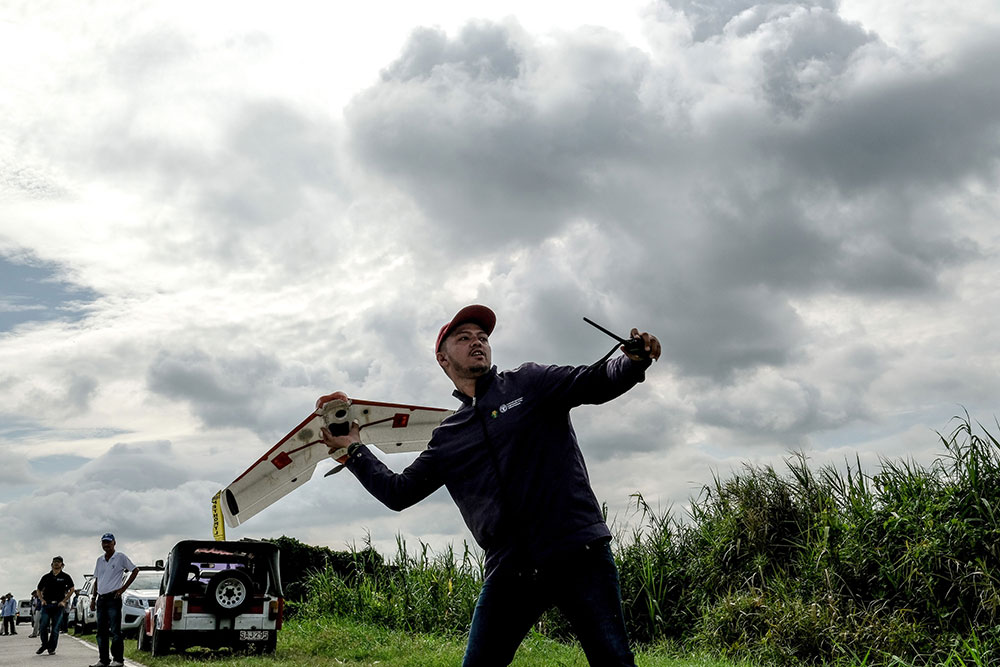
©FAO/VEEJAY VILLAFRANCA IN MAGALANG, PAMPANGA, PHILIPPINES, YOUNG AGRICULTURE PROFESSIONALS COLLABORATE WITH EXPERTS TO DEPLOY DRONES FOR ASSESSING RICE CROP DAMAGE, HIGHLIGHTING THE ROLE OF YOUTH IN ADVANCING AGRITECH SOLUTIONS FOR CLIMATE RESILIENCE.
Figure 4.12
YOUTH ALLOCATE LARGER SHARES OF THEIR TIME TO OWN AND HOUSEHOLD FARMING
Share of full-time equivalents allocated to different sectors and types of job, by age and gender
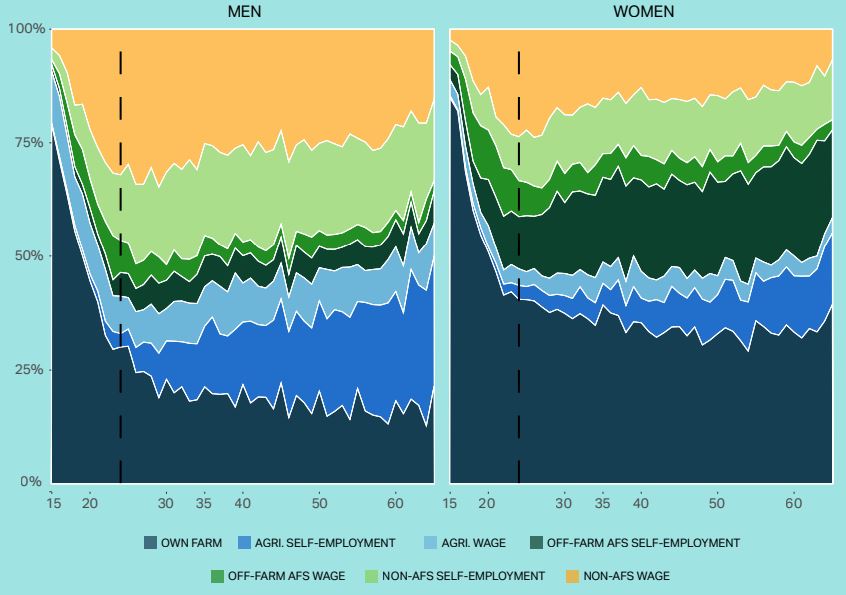
Note: The dashed line indicate the age of 24. Pooled data from four countries from sub-Saharan Africa (Malawi, Nigeria, United Republic of Tanzania, Uganda) and one country from Latin America and the Caribbean (Peru). Unweighted means.
Source: Author’s own elaboration, further processing data shared by Davis et al. 1 and building on data from the Rural Livelihoods Information System (RuLIS).71 The list of The list of surveys used for this graph is available in Appendix 3.
Beyond the number of jobs, youth are allocating more of their time to agrifood systems employment. Fulltime equivalents (FTEs) provide a more detailed picture of engagement in labour markets, accounting for seasonality and the part-time nature of work.34 In line with recent evidence,34 an analysis of FTEsd , pooling data from young and adult workers in four countries from subSaharan Africa (Malawi, Nigeria, the United Republic of Tanzania and Uganda) and one from Latin America and the Caribbean (Peru), shows that both male and female youth allocate larger shares of their FTEs to farming in their own or their household’s farm, before allocating larger shares of their time to other types of work as they grow older (Figure 4.12). This finding is in line with the higher shares of adults employed outside agrifood systems reported earlier (Figure 4.9).
Different patterns between men and women are visible as they transition to (young) adulthood. While young men appear to transition more towards non-agrifood systems wage employment and self-employment, young women and adults allocate larger shares of their time to off-farm agrifood systems employment, mostly through selfemployment. Overall, and across age cohorts, women are less likely than men to access wage employment, regardless of the sector.
INTERGENERATIONAL MOBILITY IN AND OUTSIDE AGRIFOOD SYSTEMS
As demonstrated above and in earlier chapters, exit from agriculture and agrifood systems is driven by processes of structural transformation and agrifood systems transition. These movements necessarily involve intergenerational mobility, where youth move to an employment sector offering higher returns than that of their parents.18-72-73
A study developed for this report using data from 27 surveys in 18 countries shows a positive correlation between agricultural productivity growth and intergenerational employment mobility, confirming that a vibrant agricultural and primary sector is correlated with more opportunities in other non-primary sectors (Figure 4.13, panels A and B). Countries with lower agricultural labour productivity growth, such as Malawi, Mali, Mozambique or the United Republic of Tanzania, exhibit lower youth intergenerational mobility probabilities outside of agriculture or agrifood systems. Conversely, youth in countries with higher agricultural labour productivity growth (e.g. the Plurinational State of Bolivia, Guatemala, Peru, Nigeria) are more likely to work outside of agriculture and agrifood systems, where their parents work. One of the more extreme cases is Malawi, where a stagnant primary sector provides few labour opportunities of employment outside the primary sector for younger generations. Meanwhile, Senegal, the subSaharan country in the sample with the highest growth in agricultural productivity, displays the highest share (among sub-Saharan countries) of younger employees working outside both agricultural and agrifood system employment, the sector of their parents.
YOUTH, ESPECIALLY YOUNGER YOUTH, ALLOCATE MORE TIME IN FARMING THAN OLDER COHORTS.
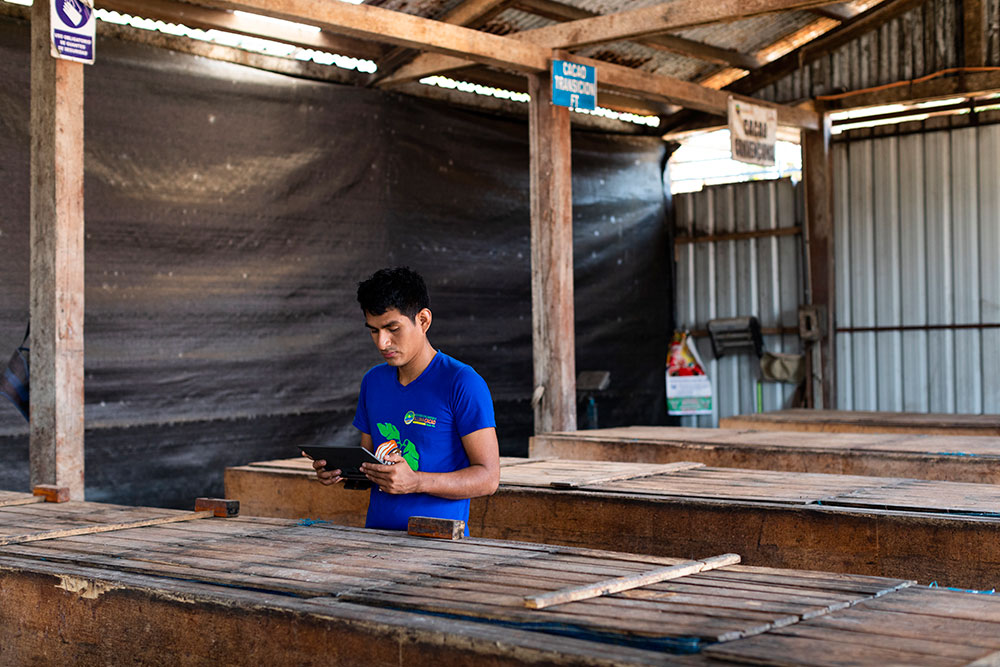
©IFAD/GIANCARLO SHIBAYAMA/ FACTSTORY IN CHAZUTA, PERU, 27-YEAR-OLD DAVID SANTOS HUANCAS, ONE OF THE YOUNGEST MEMBERS OF THE ALLIMA CACAO COOPERATIVE, LEADS PRODUCT TRACEABILITY AND DIGITAL MARKETING EFFORTS, SHOWCASING HOW YOUTH ARE USING AGRI-DIGITALIZATION TO BOOST RURAL BUSINESS, CREATE JOBS AND CONNECT SMALLHOLDER FARMERS TO NEW MARKETS.
Figure 4.13
PROBABILITY OF YOUTH ENGAGING IN A DIFFERENT SECTOR FROM THEIR PARENTS INCREASES AS COUNTRIES UNDERGO STRUCTURAL TRANSFORMATION
Share of full-time equivalents allocated to different sectors and types of job, by age and gender

Note: Data from 18 countries: Georgia, Malawi, Burkina Faso, Côte d’Ivoire, Nigeria, Guinea Bissau, Niger, United Republic of Tanzania, Mali, Uganda, Peru, Mozambique, Bolivia (Plurinational State of), Togo, Guatemala, Sierra Leone, Benin, Senegal. Three letter abbreviations are ISO Alpha-3 codes. For a full list please see: https://unstats.un.org/unsd/methodology/m49/
Source: Author’s own elaboration, further processing data shared by Davis et al. 1 and building on data from the Rural Livelihoods Information System (RuLIS).71 The list of The list of surveys used for this graph is available in Appendix 3.
Off-farm agrifood systems employment of a parent provides more opportunities for intergenerational mobility than agricultural employment. With the exception of Malawi, where intergenerational mobility is very low, the probability of the younger generation working outside agrifood systems employment is higher in all countries, when parents work in agrifood systems more broadly, than when parents work in agricultural employment exclusively (Figure 4.13, Panel C).
Yet, the possibilities for intergenerational sectoral mobility are not spread evenly across women and men (Figure 4.13). The probabilities of intergenerational mobility out of agrifood systems employment are significantly higher for males in 12 of the 18 countries considered, and larger for female youth in only 3 countries. These results indicate that social norms, particularly those assigning gender to different types of economic activities, may play an outsized role in determining intergenerational mobility and employment possibilities. They also have policy implications, as gender neutral employment policies for the young are not likely to be gender neutral in outcomes.
Figure 4.14
YOUNG WOMEN ARE LESS LIKELY THAN YOUNG MEN TO EXPERIENCE INTERGENERATIONAL MOBILITY OUTSIDE AGRIFOOD SYSTEMS
Probability of youth with parents working in agrifood systems to work outside agrifood systems, by gender

Note: Data from 18 countries: Georgia, Malawi, Burkina Faso, Côte d’Ivoire, Nigeria, Guinea Bissau, Niger, United Republic of Tanzania, Mali, Uganda, Peru, Mozambique, Bolivia (Plurinational State of), Togo, Guatemala, Sierra Leone, Benin, Senegal. Three letter abbreviations are ISO Alpha-3 codes. For a full list please see: https://unstats.un.org/unsd/methodology/m49/
Source: Author’s own elaboration, further processing data shared by Davis et al. 1 and building on data from the Rural Livelihoods Information System (RuLIS).71 The list of The list of surveys used for this graph is available in Appendix 3.
YOUTH ENGAGE IN MORE PRECARIOUS WORK IN AGRIFOOD SYSTEMS
Ensuring that youth access full and productive employment and decent work is essential to achieving SDG 8. Yet, working conditions in agrifood systems are usually more precarious than in other sectors, particularly for youth.8, 74, 50 This section assesses the working conditions of young women and men in agrifood systems, examining their status of employment, the time they work in agrifood systems, and the inequalities in specific labour and welfare outcomes to which these precarious working conditions can lead.
VULNERABLE EMPLOYMENT
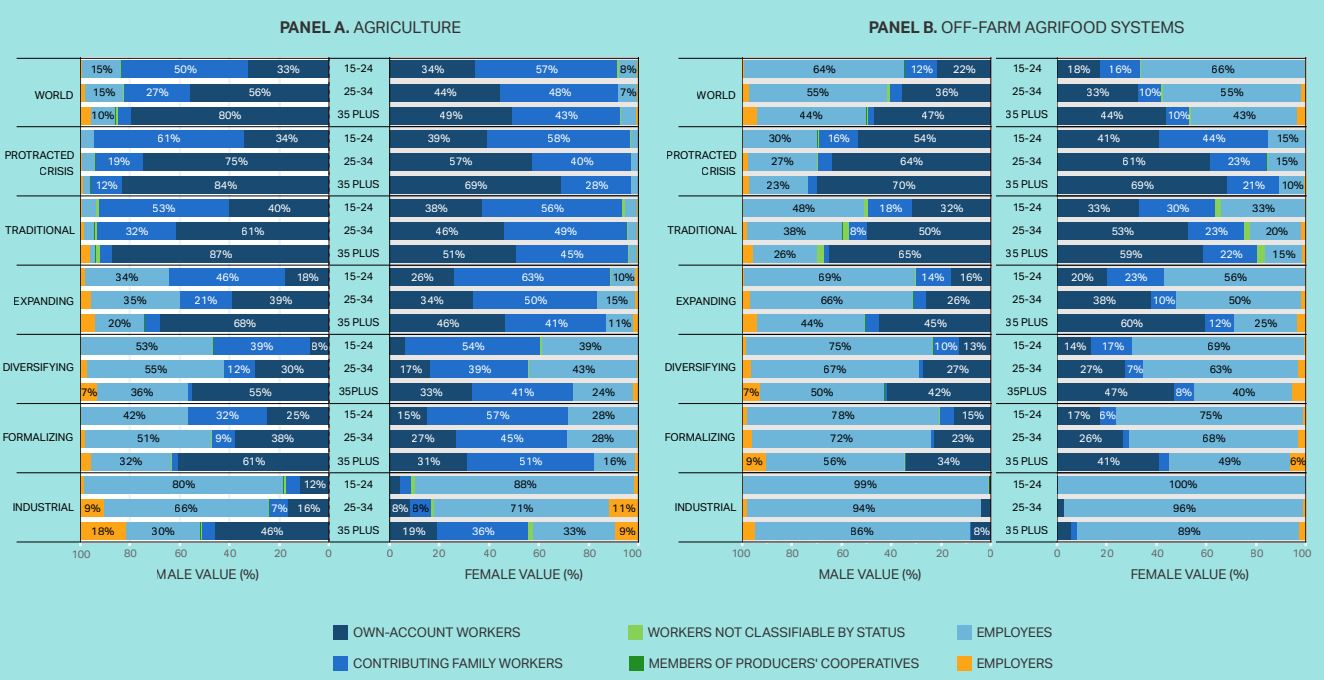
Globally, 91 percent of young women and 83 percent of young men working in agriculture are either ownaccount workers or contributing family workers, which are defined as forms of vulnerable employment.75 Whether on family farms or in other activities, they often work in informal arrangements without pay, not benefiting from social protection and are more vulnerable to various risks.32, 76 As agrifood systems transition, the share of young workers in vulnerable employment decreases (Figure 4.15, Panel A). In protracted crisis and traditional agrifood systems, more than 90 percent of young workers are in vulnerable employment, with corresponding shares of 65 percent of young men and 89 percent of young women in expanding agrifood systems.
IN 2021, 91 PERCENT OF YOUNG WOMEN AND 83 PERCENT OF YOUNG MEN IN AGRICULTURE ARE IN VULNERABLE EMPLOYMENT.
Figure 4.15
YOUTH IN AGRIFOOD SYSTEMS ARE LIKELY TO BE IN VULNERABLE FORMS OF EMPLOYMENT, ESPECIALLY IN LESS DEVELOPED AGRIFOOD SYSTEMS
Working status, by sector, gender and age cohorts (2021)
Note: Graph based on data from 61 countries:
Panel A: Protracted crisis: Afghanistan, Ethiopia, Palestine, Zimbabwe. Traditional: Cambodia, Comoros, India, Pakistan, Rwanda, Timor-Leste, Uganda, Zambia. Expanding: Angola, Bolivia (Plurinational State of), Botswana, Egypt, El Salvador, Eswatini, Georgia, Iraq, Kyrgyzstan, Peru, Sri Lanka, Thailand, Viet Nam. Diversifying: Armenia, Bosnia and Herzegovina, Ecuador, Iran (Islamic Republic of), Mauritius, Mexico, Trinidad and Tobago. Formalizing: Albania, Argentina, Belarus, Costa Rica, Cyprus, Dominican Republic, Jordan, Mongolia, North Macedonia, Portugal, Saudi Arabia, Slovakia, Türkiye, United Arab Emirates. Industrial: Australia, Austria, Czechia, France, Greece, Israel, Japan, Switzerland, United Kingdom of Great Britain and Northern Ireland.
Panel B: Protracted crisis: Afghanistan, Ethiopia, Occupied Palestinian Territory, Zimbabwe. Traditional: Cambodia, Comoros, India, Pakistan, Rwanda, Timor-Leste, Uganda, Zambia. Informal and expanding: Angola, Bolivia (Plurinational State of), Botswana, Egypt, El Salvador, Eswatini, Georgia, Iraq, Kyrgyzstan, Peru, Sri Lanka, Thailand, Viet Nam. Diversifying: Armenia, Bosnia and Herzegovina, Ecuador, Iran (Islamic Republic of), Mauritius, Mexico, Trinidad and Tobago. Modernizing and formalizing: Albania, Argentina, Belarus, Costa Rica, Cyprus, Dominican Republic, Jordan, Mongolia, North Macedonia, Portugal, Saudi Arabia, Slovakia, Türkiye, United Arab Emirates. Industrial: Australia, Austria, Czechia, France, Greece, Israel, Japan, Switzerland, United Kingdom of Great Britain and Northern Ireland.
Source: Author’s own elaboration based on ILO Harmonized Microdata, https://ilostat.ilo.org/
In diversifying and formalizing agrifood systems, these shares decrease to about half of young men and 62percent and 71percent, respectively, of young women. In these systems, most young workers in agriculture are contributing family workers. The shares drop to less than 20 percent in the industrial category.
The shares of contributing family workers among young men and women in agriculture are similar in protracted crisis and traditional agrifood systems. These high levels could be linked to lack of alternative opportunities for youth, who eventually rely on their household’s farms for their livelihoods, especially in less densely urbanized areas.34 Gender differences are more visible in expanding, diversifying, and formalizing agrifood systems. In these categories, the share of young men in vulnerable employment in agriculture decreases, as more young men are wage employees. The share of young female contributing family workers also decreases as agrifood systems transition and consolidate, but more slowly. Countries with lower fertility rates and more gender egalitarian laws concerning marriage, parenthood, and access to social protection and resources tend to have smaller gender gaps in vulnerable employment.77 Despite these improvements, a large portion of the remaining gender gaps can be attributed to gender norms and institutional frameworks that constrain women’s roles and access to decent employment.77-78
Globally, larger shares (approximately two-thirds) of both men and women in off-farm agrifood systems are employees (Figure 4.15, Panel B). The share of youth working as employees in off-farm agrifood systems increases as systems transition, from 30 percent of young men and 15 percent of young women in protracted crisis systems to practically all young men and women in industrial systems. Across all agrifood system categories, older workers, both men and women, account for higher shares of vulnerable employment than their younger counterparts. This shift to employees as agrifood systems transition reflects labour trends occurring with structural transformation, first from ownaccount workers in agriculture to own-account workers outside agriculture, before moving progressively from the latter to employees.
These trends reflect the modernization of agrifood systems and the growth of high-value chains, which has led to the generation of wage employment opportunities in rural areas, and benefited young rural women.52, 79, 80 Such jobs are typically found in agro-processing facilities and food services.52, 81 However, though the share of vulnerable employment reduces for both young men and women across agrifood systems, a consistently greater share of young women than young men are in vulnerable employment, particularly as contributing family workers (Figure 4.15). Similarly, young women in off-farm agrifood systems are more likely to be working for someone else, potentially limiting their control of income generated.34 Yet, no significant gender wage gaps are found among youth working in wage employment in agrifood systems (Box 4.2).
FULL-TIME EMPLOYMENT AND UNPAID CARE WORK
Employment in both agricultural and non-agricultural food systems is highly seasonal, driven by the nature of the agricultural calendar.82, 83 Both on- and off-farm work in agrifood systems tend to be highly seasonal,45 affecting particularly youth aged 15–19 and 20–24, who across all agrifood systems work fewer hours on average than their adult counterparts (Figure 4.16). Many youth do not necessarily aspire to work as fulltime farmers;17, 84, 85 indeed, youth from the youngest cohorts and those attending school tend to view agriculture more as a secondary or transitional activity than a long-term career.15, 18, 35, 17, 84, 85
Box 4.2
GENDER PAY GAPS AMONG YOUTH
In addition to inequalities in working conditions and access to assets (Chapter 3), youth face persistent inequalities in economic outcomes, such as pay and economic returns. Pay gaps between men and women remain widespread, particularly in low- and lower-middle income countries.i, ii Recent evidence shows that women’s wages in agriculture and non-farm employment in rural areas are significantly lower than those of their male counterparts.iii–vii,viii, ix
An analysis conducted for this report found that women aged 15–24 working in agrifood systems do not appear to be paid significantly less than their male counterparts, while those outside agrifood systems were paid 11 percent less (Table 1). The gender gaps in wages are higher for adults aged 25–34, driven primarily by “endowment effects”, or the difference in characteristics such as education, skills and equality of labour market access. This underscores the critical role that equal access to decent employment opportunities can play in reducing gender-based wage disparities, which is consistent with recent evidence showing that in areas where women have better access to full-time employment and education, the wage gap tends to narrow.iv, viii
Table A
GENDER WAGE GAPS IN AND OUTSIDE AGRIFOOD SYSTEMS, BY AGE COHORT (KITAGAWA-OAXACA-BLINDER X, XI, XII)

Notes: The analysis used a pooled sample from 14 countries, including 9 traditional agrifood systems (Bangladesh, Cambodia, Côte d’Ivoire, Ghana, Malawi, Pakistan, Senegal, Uganda, United Republic of Tanzania), 4 expanding agrifood systems (Egypt, Guatemala, Iraq and Viet Nam) and one diversifying agrifood systems (Ecuador). Wage gaps are expressed in log hourly wages in real international USD. The Kitagawa-Oaxaca-Blinder Decomposition model controls for education, proxied by whether an individual completed primary education; job characteristics, including whether the worker has a written contract, receives any fringe benefits, works full-time, has multiple jobs and whether this a low-skill job; the sector of occupation; and labour market characteristics, proxied by average agricultural and non-agricultural employment shares for different demographic groups and country fixed effects.
Source: Author’s own elaboration, using data processed by Benali et al.iv
The lack of gender wage gaps in agriculture and agrifood systems among the youngest category could be linked to the fact that youth, both men and women, engage primarily in low-skilled and low-pay wage employment in large farm holdings or off-farm activities,xiii where shadow wages, representing the opportunity cost of labour, remain low and limited prospects for productivity growth constrain the potential for increases in wages, regardless of gender.
Notes: Refer to the Notes section for full citations.
Figure 4.16
YOUTH, ESPECIALLY YOUNG WOMEN, ARE LESS LIKELY TO WORK FULL TIME
Mean weekly hours actually worked per employed person in agrifood systems (main job), by gender and age cohort (2021)

Note: Graph based on data from 47 countries: Protracted crisis: Ethiopia, Mali, Sudan, Zimbabwe. Traditional: Cambodia, Comoros, India, Pakistan, Rwanda, Timor-Leste, Uganda, Zambia. Expanding: Angola, Bolivia (Plurinational State of), Botswana, Egypt, El Salvador, Eswatini, Iraq, Kyrgyzstan, Peru, Sri Lanka, Thailand, Viet Nam. Diversifying: Bosnia and Herzegovina, Iran (Islamic Republic of), Mauritius, Mexico. Formalizing: Albania, Argentina, Belarus, Costa Rica, Cyprus, Dominican Republic, Jordan, Mongolia, North Macedonia, Portugal, Slovakia, Türkiye. Industrial: : Austria, Czechia, France, Greece, Israel, Switzerland, United Kingdom of Great Britain and Northern Ireland.
Source: Author’s own elaboration based on ILO Harmonized Microdata, https://ilostat.ilo.org/
Women disproportionately experience underemployment and are less likely than men to work full time in agrifood systems.32 Men on average work longer hours in agrifood systems than women (with the exception of the 15–19 age cohort in emerging and diversified systems) (Figure 4.16). However, women usually combine home chores with farm work25, 86, 87 and have a time burden up to four times higher than men.32
Women’s greater time burden derives from time allocated to unpaid domestic and care work,32 which constrains them from allocating more time to economic and remunerative activities88 and lowers both their participation and time spent in the labour market.32, 89 Women spend more time in unpaid care work across agrifood systems and age cohorts (Figure 4.17).90 Across all countries, women aged 15–24 allocate 2.9 times more time than men to unpaid and domestic work, with similar inequalities found for adults aged 25–44 and 45–54. At the country level, the amount of time women spend on domestic and unpaid work ranges from five times greater than men in Kenya, Guatemala and Palestine, to close to one in Finland and Sweden, where men and women spend the same or similar amount of time on domestic and unpaid care work. In five countries, inequalities between young men and young women are smaller than in older cohorts. In a few countries, though, such as the Dominican Republic, Georgia and Guatemala, young women aged 15–24 spend more time on unpaid and care work than their male counterparts, compared to older cohorts.
YOUTH WORKING IN AGRIFOOD SYSTEMS, ESPECIALLY YOUNG WOMEN, ARE LESS LIKELY TO WORK FULL TIME THAN ADULTS.
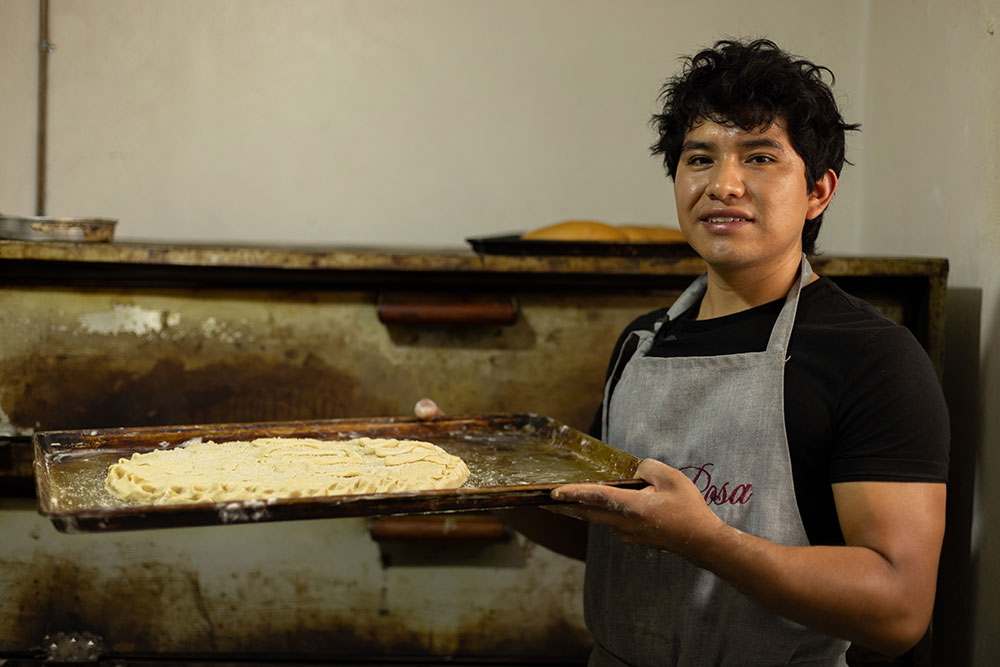
©IFAD/FERNANDA DORADO IN TLAOLA, MEXICO, YOUNG ENTREPRENEUR JOSÉ ALFREDO REVIVES THE NEARLY LOST TRADITION OF QUESADILLA FINA, USING HIS BAKERY AND DIGITAL TOOLS TO CELEBRATE INDIGENOUS CULINARY HERITAGE, EMPOWER YOUTH AND STRENGTHEN COMMUNITY IDENTITY.
Figure 4.17
ACROSS ALL AGE COHORTS, WOMEN ALLOCATE MORE TIME TO UNPAID AND CARE WORK
Female-to-male ratio of average time spent on unpaid domestic and care work within a 24-hour period

Note: Three letter abbreviations are ISO Alpha-3 codes. For a full list please see: https://unstats.un.org/unsd/methodology/m49/
Source: Author’s own elaboration using data from the United Nations Department of Economic and Social Affairs (UNDESA). 2024. Unpaid work. In: UNDESA. New York, USA. [Cited 1 January 2025].
Box 4.3
GAPS IN WORK-RELATED SOCIAL INSURANCE AND BENEFITS
Beyond wages and income, the decent work framework of the International Labour Organization (ILO) includes other forms of compensation for earnings such as paid leave, which includes paid annual and sick leave.i These types of leave, as part of broader social coverage schemes, can help stabilize incomes.ii However, they are often tied to formal jobs and are not common in sectors where informality is the norm, such as agrifood systems. Informality is a common feature of rural labour markets in low- and lower-middle-income countries, where rural youth mostly engage in informal activities.iii For these reasons, youth engaged in agrifood systems are expected to have lower social insurance coverage and benefit to a lesser extent from these types of benefits.
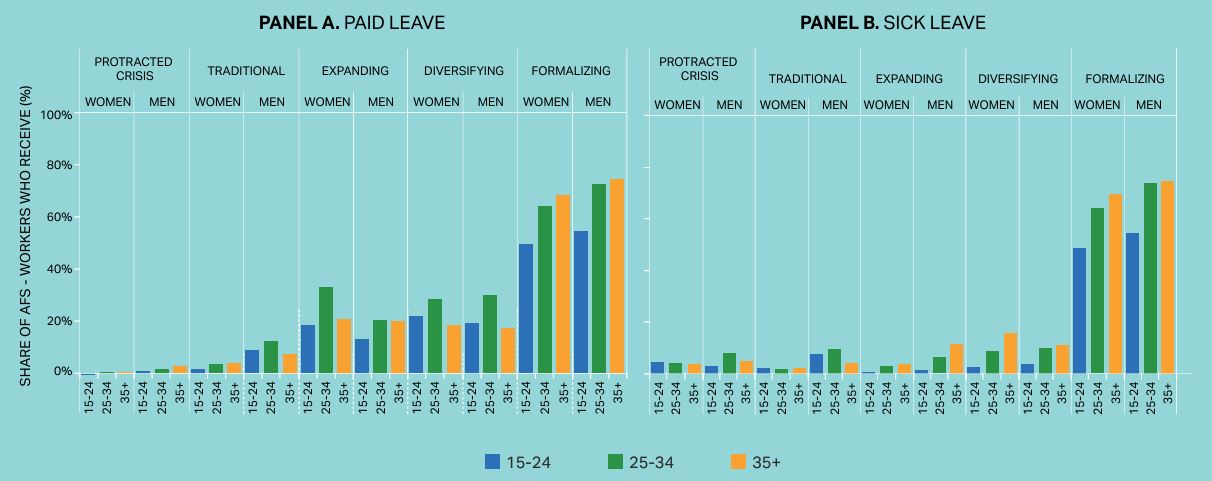
Data from the ILO enables assessment of the extent to which young women and men in agrifood systems employment benefit from paid and sick leave (Figure A). Overall, across all types of agrifood systems, youth aged 15–24 are less likely than adults to receive paid (Figure A, Panel A) or sick (Figure A, Panel B) leave. Differences between youth and adults are starker in formalizing agrifood system, while overall coverage increases as agrifood systems transition. Across all types of agrifood systems, young adults have greater access to these benefits than youth and other adults. The differences between age cohorts in terms of coverage seem to disappear in countries with more developed types of agrifood systems, in which older adults and young adults may have a similar propensity to access quality jobs.
FIGURE A. YOUTH OVERALL RECEIVE FEWER BENEFITS THAN ADULTS
Notes: Data from 82 countries.
Panel A: Protracted crisis: Afghanistan, Burundi, Mali, Palestine, Sudan, Zimbabwe. Traditional: Bangladesh, Benin, Burkina Faso, Comoros, Guinea-Bissau, India, Lao People’s Democratic Republic, Madagascar, Myanmar, Nigeria, Pakistan, Rwanda, Senegal, Timor-Leste, Togo, Uganda, United Republic of Tanzania, Zambia. Expanding: Angola, Bolivia (Plurinational State of), Botswana, Egypt, Eswatini, Gambia, Georgia, Guatemala, Iraq, Kyrgyzstan, Samoa, Sri Lanka, Viet Nam. Diversifying: Bosnia and Herzegovina, Ecuador, Mexico. Modernizing and formalizing: Albania, Argentina, Costa Rica, Dominican Republic, Jordan, Mongolia, United Arab Emirates
Panel B: Protracted crisis: Afghanistan, Burundi, Mali, Palestine, Sudan, Zimbabwe. Traditional: Bangladesh, Benin, Burkina Faso, Comoros, Guinea-Bissau, Lao People’s Democratic Republic, Madagascar, Myanmar, Nigeria, Pakistan, Rwanda, Senegal, Timor-Leste, Togo, Uganda, United Republic of Tanzania, Zambia. Expanding: Angola, Botswana, Egypt, Eswatini, Gambia, Georgia, Iraq, Kyrgyzstan, Samoa, Sri Lanka, Viet Nam. Diversifying: Bosnia and Herzegovina, Ecuador. Modernizing and formalizing: Albania, Argentina, Costa Rica, Dominican Republic, Jordan, Mongolia, United Arab Emirates. The graphs do not include information from countries with industrial agrifood systems as the number of countries from this group was too low.
Source: own elaboration based on ILO Harmonized Microdata, https://ilostat.ilo.org/
Notes: Refers to the Notes section for full citations.
SPOTLIGHT 4.1 IN LOW-AND LOWER-MIDDLE-INCOME COUNTRIES, YOUTH ENGAGEMENT IN AGRIFOOD SYSTEMS DEPENDS ON THE SPACES IN WHICH THEY LIVE
Structural transformation is characterized by urbanization and changing rural-urban linkages.i, ii These linkages yield a diversity of spaces in terms of distance to urban centres and densely populated areas, as well as access to activities and services.iii, vThe diversity of these spaces translates into an array of economic opportunities and livelihoods as well as challenges for youth and adults.iv, vi–ix
Recent evidence shows that youth engagement in specific employment is shaped by the opportunities available in the spaces in which they live.vi, vii, x Analysis developed for this spotlight builds on this existing spatial framework presented in Chapter 2 with information on access to markets (proxied by travel time to different types of spaces) and digital connectivity (proxied by access to different type of mobile networks), building a new and more disaggregated categorization of spaces ranging from severe challenges to high opportunities (adapting the framework presented in Chapter 2).
The results confirm that youth engagement in agrifood systems depends heavily on spatial contexts ( (Figure A, Panel A ) Panel A Across a sample of 18 low- and lower-middle income countries, agrifood systems employment remains important across all types of spaces, but is more significant in spaces characterized by low connectivity – either those with low land productivity (severe challenges spaces) or those with higher land productivity, yielding more agricultural opportunities.
Across all spaces, agrifood systems remain a key entry point for youth, as noted earlier in this chapter. However, the nature and patterns of engagement in agrifood systems vary significantly between the different type of spaces. In spaces characterized by severe challenges or agriculture opportunities, young female adults remain and work more than male youth, while young male adults exit agrifood systems, as shown in Figure 4.3. In spaces characterized by low connectivity, and thus potentially lower mobility, young women may not be able to access livelihood opportunities outside agriculture. Women’s limited mobility,xi, xii combined with their domestic and child care responsibilities,xiii can thus further limit their engagement in off-farm (agrifood systems) employment in less connected spaces. In spaces with higher degrees of connectivity, young women may be more able to access off-farm opportunities located outside or further from the household’s location.
While agriculture remains key for youth livelihoods in low or medium opportunity spaces, off-farm agrifood systems are more important for youth in mixed, diverse and market opportunities spaces, especially women. As connectivity increases, larger shares of women engage and take advantage of off-farm agrifood systems opportunities generated by greater proximity or easier access to urban areas and consumer demand.ii This dynamic is most apparent in spaces with market opportunities, where higher levels of offfarm agrifood systems employment are observed. In these contexts, off-farm employment may form part of a livelihood diversification strategy, to potentially offset the reduced income from agriculture resulting from lower land productivity. Yet, in the diverse opportunities settings, where land productivity is higher, women aged 25–34 engage less in agriculture and more in off-farm agrifood systems, which could be indicate that women from this group eventually tend to exit agriculture when opportunities outside the sector are available – a pattern possibly driven by increases in agricultural productivity.
Even when all working-age youth are taken into consideration, not just those in employment, agrifood systems employment remains critical for young people ( Figure A,Panel B ). Agriculture remains key in spaces constrained by severe challenges, while larger shares of working-age youth diversify their activities in low connectivity spaces with higher agriculture opportunities, either within agrifood systems, combining and agricultural and off-farm agrifood systems employment, or outside agrifood systems combining agrifood system employment with work. In high connectivity spaces, while slightly less or about half of youth still rely on agriculture, larger shares of youth have no job, potentially exiting the labour force to either pursue education – understanding that educational attainment is higher in urban areas (see Chapter 3 – or being unemployed, taking into consideration the typically higher unemployment and NEET rates among urban youth.xiv Specialization in nonagrifood systems employment increases in spaces with medium to high connectivity, with a stronger rise among youth aged 20–24, reflecting the importance of nonagrifood systems employment in spaces in or closer to peri-urban and urban areas.i-xv

©FAO/A.K. KIMOTO IN SIEM REAP, CAMBODIA, LAND SINOUN PROUDLY SHOWS VISITORS HER THRIVING HOME GARDEN, DEMONSTRATING HOW SMALLSCALE AGRICULTURAL SUPPORT CAN EMPOWER RURAL WOMEN AND FOSTER COMMUNITY RESILIENCE.
FIGURE A. AGRIFOOD SYSTEM EMPLOYMENT IS MORE IMPORTANT IN LESS CONNECTED SPACES

Notes: A/L: Low agricultural potential, C-L: Low connectivity, A/M: Medium agricultural potential, M-L: Medium connectivity, H/L: High agricultural potential, C-H: High connectivity.Data from 18 countries (Benin, Côte d’Ivoire, Burkina Faso, Guinea Bissau, Togo, Senegal, Niger, Bolivia (Plurinational State of), Guatemala, Mozambique, United Republic of Tanzania, Uganda, Georgia, Mali, Malawi, Nigeria, Peru, Sierra Leone).
Source: Own elaboration, further processing data shared by Davis et al.xvi and building on data from the Rural Livelihoods Information System (RuLIS).xvii
Notes: Refer to the Notes section for full citations.
SPOTLIGHT 4.2 CHILD LABOUR AMONG THE 15–17 COHORT
Little attention has been paid to youth aged 15–17, who belong to both the children (0–17) and youth age groups.i This cohort is characterized by specific biological, developmental and legal characteristics that distinguish them from older youth and adults. Biologically, youth aged 15–17 are in the later part of adolescence, a crucial stage of physical and cognitive development, characterized by biological growth and social transitions.ii, iii Individuals from this group have reached legal working age (set at 14 years old in some countries, and 15 or 16 years old in most countries) and can be in employment.i,iv,v T hey often face conflicting expectations and frequently engage in work that may be inappropriate for their age or development while lacking corresponding rights, voice or access to resources, which places them at heightened risk of involvement in child labour, particularly its worst forms.iv According to ILO Conventions Nos. 138 and 182, if they are involved in hazardous work, these youth are considered to be in a situation of child labour,v,vi which can have longterm negative implications for employment and health outcomes.i, vii
Thirty-five million youth aged 15–17, representing 9.5 percent of this cohort, are in a situation of child labour and hazardous work.viii Agriculture is more prone to hazardous workix and employs 47.6 percent of all youth aged 15–17 in hazardous work.viii Children face a wide array of hazards and risks in the sector, including exposure to chemicals and extreme weather and temperatures, handling of dangerous tools and machinery, strenuous physical work, with heavy loads and repeated movements, or working with certain animals.i, viii The prevalence of child labour and hazardous work among youth aged 15–17 occurs more often in low- and lower-middle-income countries,viii where youth below the age of 18 generally work as contributing family workers in agriculture.iv, viii
Youth in child labourvii and hazardous workviii are less likely to be attending school or completing graduation. Besides the inherent health and physical and cognitive development risks associated with hazardous work, lower school attendance can eventually compromise children and youth’s potential to build required professional skills and hamper future employment outcomes.vii The toll taken on youth’s health and education can reduce their skills and productivity, further affecting their livelihoods and hampering the capacity of agrifood systems to ensure sustainable future food production.iv
Youth aged 15–17 face multiple challenges which heighten their vulnerability to hazardous forms of work and constrain their capacity to safely engage with agrifood systems. Compared to older youth (18–24), this cohort lacks the financial autonomy and legal capacity to own or access assets required for productive engagement in agrifood systems (see Chapter 3). For instance, evidence shows that they are less likely to own or access land, non-land and political assets than older youth.x Combined with their limited education, the lack of alternative productive and decent employment opportunities in rural areas often constrain youth aged 15–17 to work in subsistence agriculture or take up poor quality and low-paid jobs in off-farm segments of agrifood systems.iv Enforcement of child labour laws is also particularly challenging,vii, viii even more so in remote areas.i Data on the activities youth perform in agriculture and the related conditions are scarce, limiting the capacity to monitor and identify situations of child labour and hazardous work for this cohort
Different patterns emerge as to girls’ and boys’ vulnerability to child labour and hazardous work in agriculture and broader agrifood systems. Child labour and hazardous work is more prevalent among boys than girls within the 15–17 age cohort (12.2 percent against 6.6 percent, respectively).vii They typically engage in different activities. Boys tend to be more involved in hazardous agricultural work, including heavier work in the field and work with livestock, while girls tend to engage in activities that are closer to the family home, including postharvest activities involving smaller livestock and the marketing of agricultural products.iv
Girls are also more likely to be engaged in household chores in their own homes.xi, xiv These “invisible” tasks are not always included in the definition of child labour but increase their overall work burden.viii Cultural norms in many regions constrain girls’ mobility and limit their access to education, thereby reducing their opportunities for formal agricultural training and decent employment. Adolescent girls and young women, in particular, often face compounded barriers, including heightened risks of physical and emotional violence, discrimination and harassment, which further marginalize their participation in the agrifood sector.xv
Promoting safe work in agrifood systems for youth aged 15–17
Agrifood system employment remains critical for youth aged 15–17, especially in countries at the earlier stages of agrifood systems transition. Ensuring that youth aged 15–17 can access legal, non-hazardous work is thus critical, including for the sustainability of agrifood systems.iv Protection of youth aged 15–17 from hazardous work in agrifood systems can be achieved through multiple approaches, targeting individual workers, their households and broader rural areas. First, young workers in agrifood systems should be protected from hazardous working conditions. For instance, promoting sustainable agricultural practices and labour-saving technologies can help reduce youth’s exposure to agrochemicals and dangerous equipment.i, iv Nonstate actors-based monitoring systems can also help identify situations of child labour in more remote areas and the informal economy.viii Second, targeted efforts should aim at reducing youth’s likelihood to engage in hazardous work. Supporting their education and sector-specific skills training can help youth access decent and more productive jobs.iv In the same vein, interventions supporting rural and agricultural households can help reduce their likelihood to resort to child labour. Evidence shows that interventions combining livelihood and education support, such as in Peru,xvi or food-for-education programmes, such as in Burkina Faso,xvii can help reduce child labour in agricultural households. Third, broader investments and rural development policies (including in basic infrastructure, health and education) that aim to generate decent, quality and remunerative work opportunities are also essential. Besides offering decent alternatives to hazardous work to youth aged 15–17, both in and outside agrifood systems, prospects of better-quality jobs will encourage families to prioritize long-term youth education and training over child labour generated income.iv
Notes: Refers to the Notes section for full citations.
SPOTLIGHT 4.3 INDIGENOUS YOUTH’S WORK AND ACCESS TO ASSETS AND RESOURCES IN AGRIFOOD SYSTEMS
Forty-five percent of the world’s estimated 476 million Indigenous Peoples are between 15 and 30 years of age.i While Indigenous Peoples constitute approximately 6.2 percent of the global population, with the majority living in middle-income countries, some sources place them among the most economically poor, representing more than 19 percent of the extreme poor.i It is important to note that for many Indigenous Peoples around the world, across the seven sociocultural regions, their ways of life are intricately connected to food and knowledge systems embedded within the diverse ecosystems of their territories and homelands, and not necessarily measured by economics and labour. For Indigenous Peoples, including Indigenous Youth, food is more than just eating – food carries nutritional, medicinal, healing, spiritual, social, cultural, relational and emotional dimensions and values. ii From an economics perspective, many Indigenous Peoples are dependent on agrifood systems for their livelihoods: the ILO estimates that 55 percent of Indigenous Peoples work in agriculture (compared to 27 percent in the non-Indigenous population). There is little to no disaggregated data available for Indigenous Youth by occupation.iii
Despite this lack of data, there is an increasing emphasis on documenting the important role that Indigenous Youth play in protecting and advocating for Indigenous Peoples’ food and knowledge systems, the conservation of biodiversity, climate change adaptation, ecological restoration and food systems transformation in their communities. Indigenous Youth also actively participate in global forums including the Convention on Biological Diversity (CBD), the UN Convention to Combat Desertification (UNCCD), the UN Framework Convention on Climate Change (UNFCCC) Conference of Parties (COP) and the UN Global Indigenous Youth Forum (UNGIYF). As with food, Indigenous Peoples and Indigenous Youth protect and prioritize biodiversity for its importance not just for their livelihoods but also for cultural, spiritual and symbolic reasons.iv
Additionally, interest is growing in better measuring and assessing the extent to which Indigenous Peoples, including Indigenous Youth, work in “traditional occupations”, many of which are related to agrifood systems, such as hunting, gathering (including plants for both food and medicine), herding, fishing and aquaculture, pastoralism, cultivation, farming, beekeeping, forestry, the production of handicrafts (e.g. weaving, basketry, pottery, carving), and the preparation and storage of foods.v Such “traditional occupations” are intrinsically connected to the characteristics and collective stewardship required to sustain their food systems and territorial management. According to FAO’s White/Wiphala Paper on Indigenous Peoples’ food systems,ii “Indigenous Peoples’ food systems consist of both food generation and food production, and different Indigenous Peoples’ communities may participate in food generative and productive activities to differing extents”.ii
Within these traditional occupations in agrifood systems, young Indigenous Peoples also play important roles in innovating, changing and adapting practices. For example, in Thailand, Indigenous Youth combined work with traditional agricultural practices with an innovative business model to create a community-based social enterprise.vi In the Philippines, youth members of the Lake Sebu Indigenous Women and Farmers Association advanced a project to make and sell banana chips during the COVID-19 pandemic to prevent food loss and waste due to interrupted supply chains. The bananas used were native species, which had greater resilience to climate change. This project increased and diversified income for youth and their families, while incorporating sustainable practices and promoting biodiversity.vii
Many Indigenous Youth around the world are under increasing pressure to relocate to urban centres for reasons including economic opportunities or displacement. In spite of this, many Indigenous Youth are finding ways to remain connected with their cultures and food systems. For example, Indigenous Youth from the Anishnaabeg community in Canada demonstrated that rather than representing a loss of cultural traditions, their rural–urban mobility for work and education has helped finance traditional activities such as hunting, trapping, fishing and plant collection.viii Additional examples from Northern America reveal Indigenous Youth sustaining and revitalizing their food and knowledge systems in both rural and urban areas, while protecting ecosystems through the cultivation and use of native species in culinary and production businesses, ranching, wild harvesting, fishing and hunting ix, x, xi. In Alaska, Indigenous Youth are collaborating with remote Native villages, planting food and native species to stabilize melting permafrost, and increase local food production and access to affordable, nutritious food.xii
In consultations held during the 2023 UN Global Indigenous Youth Forum and at World Food Forums since 2021, more than 200 Indigenous Youth leaders from across the seven sociocultural regions have shared initiatives they are leading to support Indigenous Peoples’ food and knowledge systems.xiii Indigenous Youth from across Central and South America and the Caribbean are working to preserve and protect varieties of seeds and plant genetic resources through cultivation based on the milpa system. In the Amazon basin of Ecuador, Indigenous Youth are creating their own alternative economies founded on the plants, foods and medicines of their region. In Mexico, Indigenous Youth and Women face encroachment on their agricultural and grazing lands from wind projects and are advocating for Free, Prior and Informed Consent (FPIC) in relation to green energy projects.xiv
Indigenous Youth of the Ogiek People in Kenya and the Hunter-Gatherer Peoples in the Congo Basin are advocating to retain access to their homelands and sustain their traditional systems of forestry. Indigenous Youth in Botswana, Namibia and the United Republic of Tanzania are combating desertification and drought by applying new pastoralism approaches, restoring grasslands and planting small gardens for mobile schools.xv, xvi Indigenous Youth of the Kal Tamashek in Burkina Faso are identifying ways to sustain their nomadic livelihoods with livestock and wild harvests in the face of desertification and political violence.xvii
Saami Youth across Scandinavia are actively engaged in protecting grazing lands for their reindeer herds and are finding ways to sustain their mobile livelihoods despite encroachment and climate change impacts.xviii Indigenous Youth in the Arctic regions of Alaska, the United States of America and Nunavut, Canada are studying arctic marine life with the aim of sustaining traditional hunting, whaling and fishing practices in sustainable ways.xix
Indigenous Youth in Arctic regions of the Russian Federation are also working to maintain their food systems, which are rooted in hunting, fishing and reindeer herding, despite territorial challenges and climate change.xx In the North Caucasus, Indigenous Youth are collaborating with Indigenous chefs and food historians to learn about and share traditional foods and preservation practices.xxi
In the Pacific, Indigenous Youth in Vanuatu and other small island nations are encouraging their communities to cultivate traditional varieties of foods using Indigenous practices, in order to increase food security and nutritional health.xxii In the Solomon Islands and Timor-Leste, Indigenous Youth are working together with Elders and the local government to monitor and sustain Indigenous fisheries and sustainable practices.xxiii Similarly, Indigenous Youth across Australia are working alongside Elders to sustain their Indigenous food and knowledge systems, re-establish connections and reacquire lost knowledge.xxiv In Hawaii, young Kanaka Oiwi (Native Hawaiians) are revitalizing fishponds and restoring Indigenous food and knowledge systems linked to “ahupua’a” watersheds.xxv Indigenous Youth in New Zealand are working to reconnect with their traditional whenua (lands) and restore spaces for cultivation.xxvi
While Indigenous Youth are leading initiatives around the world to protect, preserve and revitalize Indigenous Peoples’ food and knowledge systems in the broader context of agrifood systems, there is a lack of disaggregated and published data on their initiatives. This data gap is slowly being addressed.
One way to better understand the access and opportunities open to Indigenous Youth is to analyse employment data, although the variations in these data are depending on region and national context. Data from two industrial agrifood systems with large populations of Indigenous Peoples – Australia and the United States of America – demonstrate significant gaps. In Australia, the employment rate in 2021 for Indigenous Youth was 44 percent compared to approximately 60 percent for non-Indigenous Youth. Additionally, 42 percent of Indigenous Youth are not in employment, education or training (NEET). These outcomes are due in part to the challenges that Indigenous Youth and adults face in Australia, including discrimination, disproportionately high rates of incarceration, disparities in the educational system, and lack of access to training and long-term job opportunities, as well as the absence of mentorship for Indigenous Youth seeking employment.xxvii
Data from the United States of America (2016) show similar patterns, with unemployment higher for Indigenous Youth aged 20–24 years (24 percent) than for any other ethnic group, and greater for Indigenous Youth aged 16–19 (27 percent) than for all groups except black youth (32 percent). In both cohorts, the unemployment rate for Indigenous Youth is significantly higher than for white youth (19 percent among ages 16–19 and 9 percent for ages 20–24). In the United States of America, 19 percent of young farm workers aged 14–19 were Indigenous (compared to 2 percent for the population overall), and 6 percent spoke an Indigenous language as their primary language.xxviii, xxix
These gaps are reflective of specific challenges that Indigenous Youth face in agrifood systems. These include lack of access to land and water, xxix, xxx, xxxi limited participation in policy processes and governance structures, reduced access to ICTs compared to urban and/or non-Indigenous Youth, and lower rates of school completion. For example, data from 2011 show that Indigenous Youth in Guatemala were almost 12 percentage points less likely to complete primary school, and almost 13 percentage points less likely to complete secondary school. In Ecuador, Indigenous Youth are more than 16 percentage points less likely to complete secondary school. Further gaps are noticeable between young Indigenous women and men, and between young Indigenous people living in rural and urban areas (see Figure A for statistics on the Plurinational State of Bolivia). While the trend in Latin America improved significantly between 2000 and 2011, and varies across countries in the region, significant gaps – including urban/rural and gender gaps – persist with consequent impacts for Indigenous Youth on skills and labour force participation.xxx

© FAO/ADRIANO GAMBARINI/OPAN ON RIVER TAPAUÁ IN THE BRAZILIAN AMAZON, A YOUNG MAN SITS ON A WATER VESSEL IN THE LANDS OF THE PAUMARI INDIGENOUS PEOPLE.
FIGURE A. INDIGENOUS YOUTH, ESPECIALLY YOUNG INDIGENOUS WOMEN, ARE LESS LIKELY TO COMPLETE EDUCATION IN RURAL AREAS OF THE PLURINATIONAL STATE OF BOLIVIA

Source: World Bank. 2015. Indigenous Latin America in the twenty-first century. Washington, DC. https://documents1.worldbank.org/curated/en/145891467991974540/pdf/Indigenous-Latin-America-in-the-twenty-first-century-the-first-decade.pdf
Finally, loss of cultural heritage including the disappearance of Indigenous languages, which is particularly acute among Indigenous Youth, can also contribute to lack of access to resources and job opportunities. For example, in Mexico, the adoption of Spanish as their primary language, by Indigenous Youth from the Cucapa people, has been used to deny them official recognition as Indigenous, thereby reducing their access to fishing rights and land.xxxii
Despite these challenges, Indigenous youth are also leading and participating globally in initiatives to retain, restore and revitalize their Indigenous languages, as well as to strengthen the language skills they need in the job market and international negotiations. It is important to note that for many Indigenous Youth, educational systems in their countries have historically been and continue to be a place of assimilation and separation from their cultures, values, systems of knowledge, languages, foods and ways of life. In recognition of this issue, Indigenous-led education initiatives around the world are giving Indigenous Youth a way to access education while also retaining and strengthening these connections and sustaining their food and knowledge systems.xxxiii,xxxiv
To gain a better understanding of Indigenous Youth’s work and access to assets and resources in agrifood systems, it is important to understand their motivations and the challenges they face in today’s world. Options to complete their education under the “mainstream” system and work in the agriculture sector may or may not be accessible, nor serve the goals of protecting and sustaining Indigenous Peoples’ food and knowledge systems.
Notes: Refers to the Notes section for full citations.

©IFAD/SANTIAGO BILLY/ FACTSTORY IN QUICHÉ, GUATEMALA, JUANA MORALES RODRÍGUEZ, A YOUNG MOTHER OF THREE AND RURAL CREDIT UNION LEADER, USES SOLAR POWERED DIGITAL TOOLS TO MANAGE GROUP SAVINGS AND GROW HER FAMILY-RUN WEAVING BUSINESS, SHOWING HOW DIGITAL INCLUSION EMPOWERS RURAL WOMEN ENTREPRENEURS.


FAO. 2025. The status of youth in agrifood systems. Rome. https://doi.org/10.4060/cd5886en
The designations employed and the presentation of material in this information product do not imply the expression of any opinion whatsoever on the part of the Food and Agriculture Organization of the United Nations (FAO) concerning the legal or development status of any country, territory, city or area or of its authorities, or concerning the delimitation of its frontiers or boundaries. Dashed lines on maps represent approximate border lines for which there may not yet be full agreement. The mention of specific companies or products of manufacturers, whether or not these have been patented, does not imply that these have been endorsed or recommended by FAO in preference to others of a similar nature that are not mentioned.
ISBN 978-92-5-139920-0
© FAO, 2025

Some rights reserved. This work is made available under the Creative Commons Attribution- 4.0 International licence (CC BY 4.0: https://creativecommons.org/licenses/by/4.0/legalcode.en).
Under the terms of this licence, this work may be copied, redistributed and adapted, provided that the work is appropriately cited. In any use of this work, there should be no suggestion that FAO endorses any specific organization, products or services. The use of the FAO logo is not permitted. If a translation or adaptation of this work is created, it must include the following disclaimer along with the required citation: “This translation [or adaptation] was not created by the Food and Agriculture Organization of the United Nations (FAO). FAO is not responsible for the content or accuracy of this translation [or adaptation]. The original [Language] edition shall be the authoritative edition.”
Any dispute arising under this licence that cannot be settled amicably shall be referred to arbitration in accordance with the Arbitration Rules of the United Nations Commission on International Trade Law (UNCITRAL). The parties shall be bound by any arbitration award rendered as a result of such arbitration as the final adjudication of such a dispute.
Third-party materials. This Creative Commons licence CC BY 4.0 does not apply to non-FAO copyright materials included in this publication. Users wishing to reuse material from this work that is attributed to a third party, such as tables, figures or images, are responsible for determining whether permission is needed for that reuse and for obtaining permission from the copyright holder. The risk of claims resulting from infringement of any third-party-owned component in the work rests solely with the user.
FAO photographs. FAO photographs that may appear in this work are not subject to the above-mentioned Creative Commons licence. Queries for the use of any FAO photographs should be submitted to: photo-library@fao.org.
Sales, rights and licensing. FAO information products are available on the FAO website (www.fao.org/publications) and print copies can be purchased through the distributors listed there. For general enquiries about FAO publications please contact: publications@fao.org. Queries regarding rights and licensing of publications should be submitted to: copyright@fao.org.
Cover image: © FAO/Heba Khamis