6. Ownership and management rights

Clear and secure forest ownership and management rights are important for encouraging public and private investment in forests and for alleviating the poverty of people who depend directly and indirectly on forests for their livelihoods. Accurate information on these, therefore, is crucial for SFM and human well-being and for the formulation of effective forest policies on this aspect of forest management.
FRA 2025 collected information on ownership and management rights for 1990, 2000, 2010, 2015 and 2020; 2020, therefore, is the reference year for status analysis. Four main forest ownership categories were assessed: 1) public; 2) private; 3) other; and 4) unknown (because of their small size, the latter two are combined – as “other/unknown” – in the data presented here). The “private” category has three subcategories: 1) forest owned by individuals; 2) forest owned by private business entities or institutions; and 3) forest owned by Indigenous Peoples and local communities.
FRA 2025 also collected information on who holds management rights in public forests, defined as the right to manage and use publicly owned forests for a specified period. Five main categories of management rights-holders were identified: 1) public administrations; 2) private business entities and institutions; 3) Indigenous Peoples and local communities; 4) other; and 5) unknown (because of their small size, the latter two are combined – as “other/unknown” – in the data presented here).
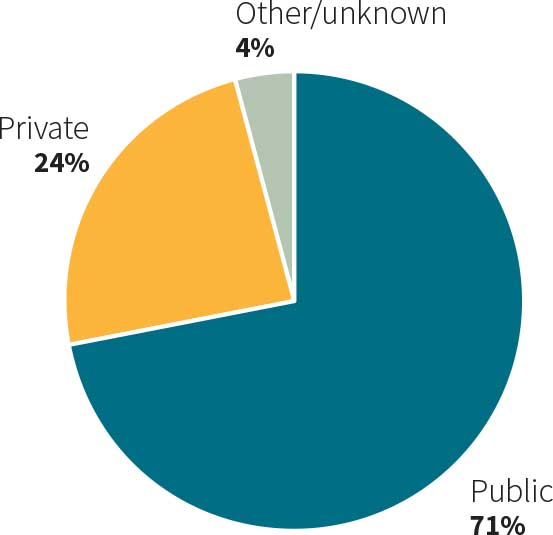
FRA 2025 received data on (or, for desk studies, made estimates of, based on available information) forest ownership in 2020 for all 236 countries and areas included in the assessment. Analysis of these data indicates that 71 percent of the world’s forests were publicly owned in 2020; private ownership accounted for another 24 percent; and the remainder (4 percent) was categorized as other/unknown (mainly comprising mixed or undeclared ownership) (Figure 40).
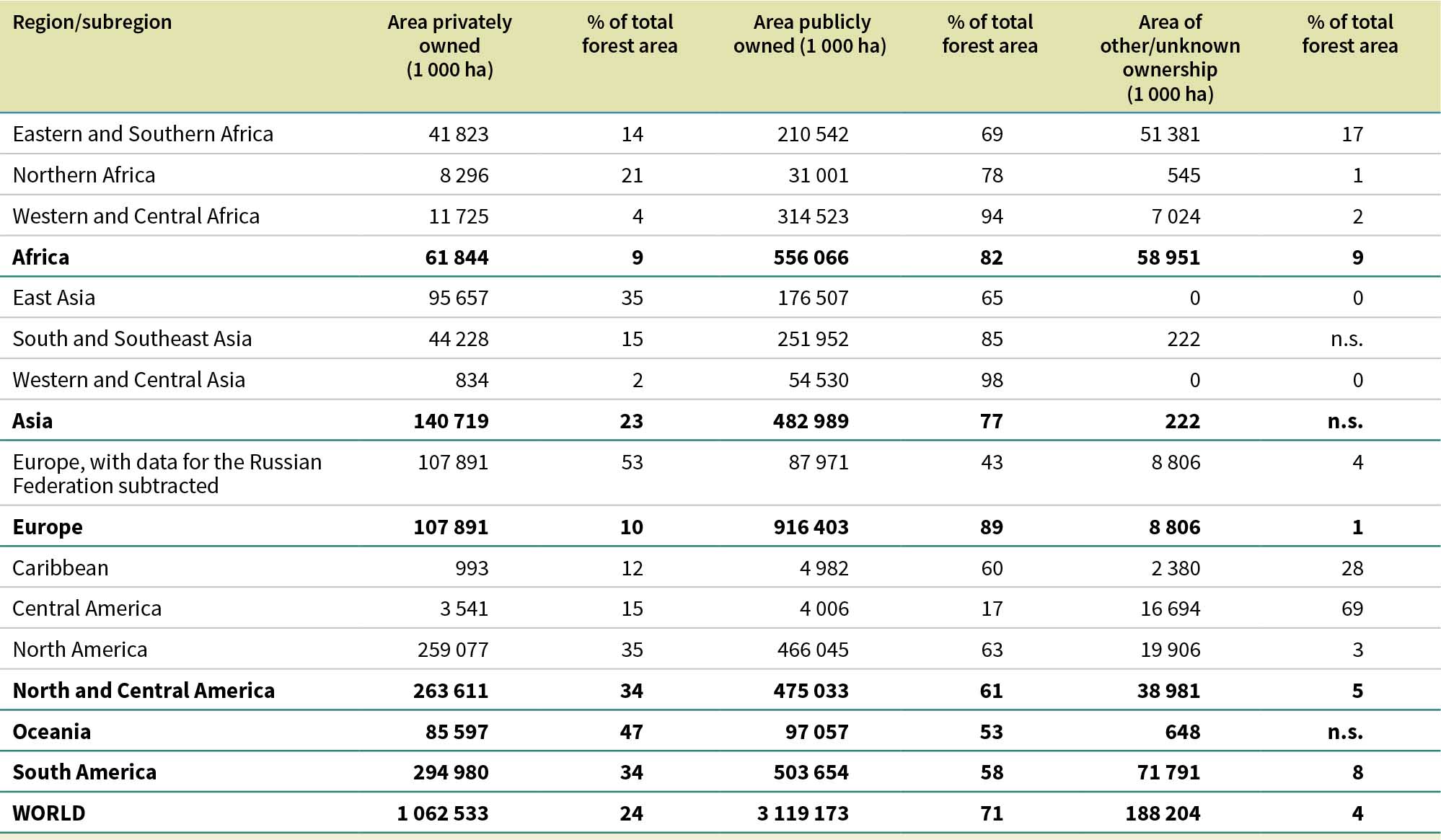
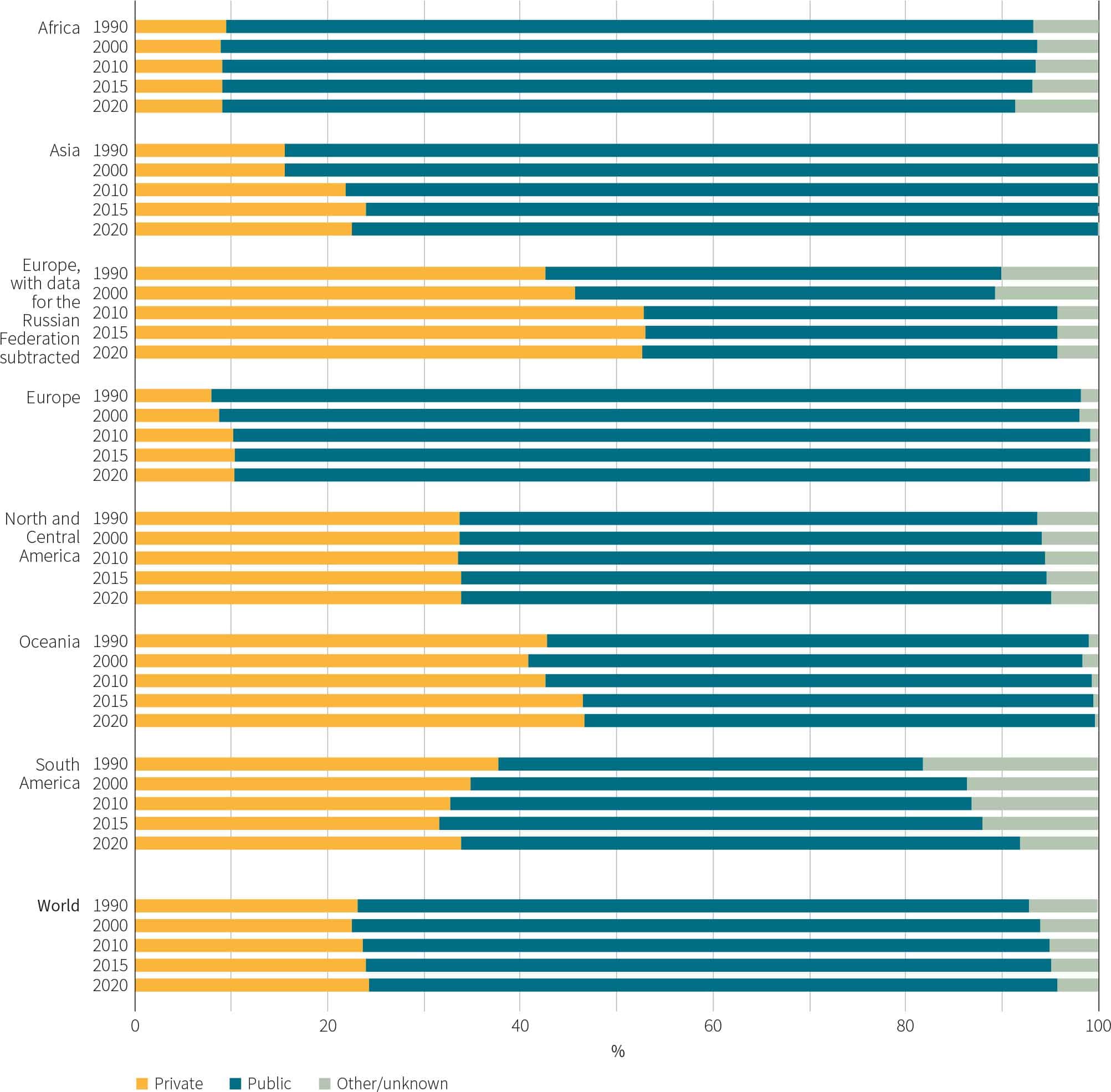
Public was the predominant ownership category in all regions, although private ownership has the lion’s share in Europe (accounting for 53 percent of the region’s forest area) if data for the Russian Federation are subtracted. Public ownership applied to almost the entire forest area (98 percent) in Western and Central Asia in 2020 and to 94 percent of the forest area in Western and Central Africa and 85 percent in South and Southeast Asia (Table 77; Figure 41). The highest share of private ownership was in Oceania, at 47 percent, followed by East Asia and North America, both at 35 percent. The ownership of 69 percent of the forest area in Central America was other/unknown.
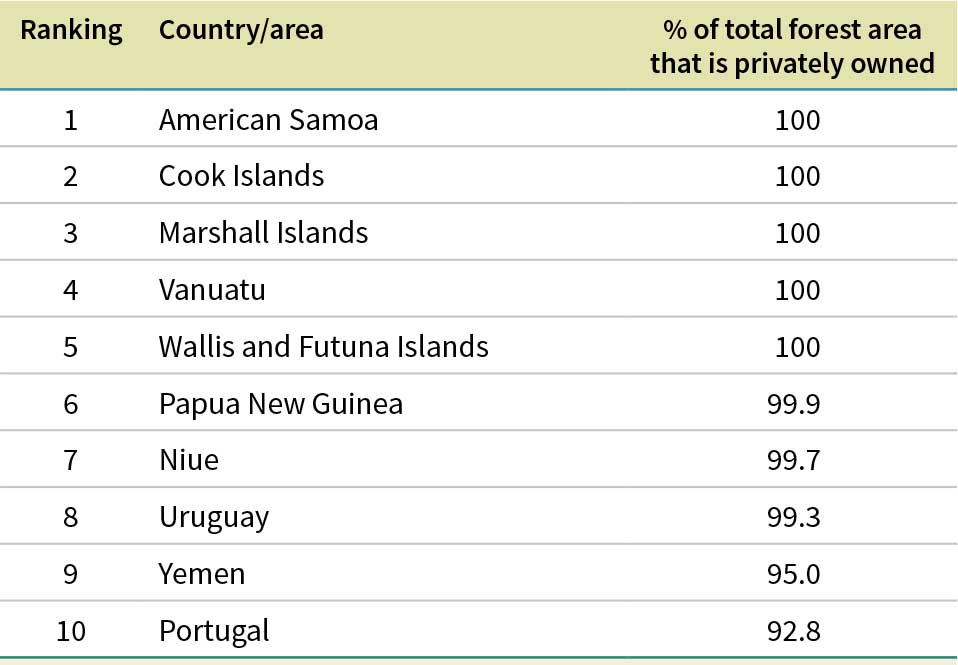
Ninety countries and areas – of which 71 are in Africa and Asia – reported that more than 90 percent of their forests was publicly owned in 2020. Five countries and areas (all in Oceania) reported that the entirety of their forest area was privately owned (Table 78).
Globally, the share of total forest area designated as other/unknown decreased between 1990 and 2020, indicating increased clarity on ownership. The shares increased slightly for both public and private ownership over the period. Differing trends are evident regionally: for example, the share of publicly owned forest decreased over the period in Africa, Asia, Europe and Oceania and increased in North and Central America and (by more) in South America. The share of privately owned forest decreased in South America, from 38 percent in 1990 to 34 percent in 2020, due mainly to Brazil, where the area of private forest decreased from 365 million ha to 227 million ha over the period. The share of private forest increased in Asia, from 16 percent in 1990 to 23 percent in 2020, mainly reflecting an increase in China, where the area of private forest grew from 27.5 million ha in 1990 to 76.9 million ha in 2020. The share of privately owned forest also increased in Europe and Oceania and was relatively steady in Africa and North and Central America. The other/unknown ownership category decreased over the period in all regions except Africa (mainly because of large areas of unknown ownership reported in Eastern and Southern Africa).
FRA 2025 received information on the area of forest owned by subcategories of private owner in 2020 from 140 countries and areas representing 55 percent of the world’s forest area; given this relatively low proportion of representation, findings may not be representative at the global level. Reporting was particularly low in Oceania and South America, and it was not possible to derive trends for these two regions. The analysis reported here is based on a subset of countries and areas that reported on all three subcategories of private forest ownership; those that reported on only one or two of the subcategories were excluded.
Of the total area of privately owned forest in 2020, 48 percent was owned by individuals, 30 percent was owned by Indigenous Peoples and local communities, and 23 percent was owned by private business entities and institutions (Table 79). Ownership by individuals was predominant in Europe (where it represented 79 percent of the total forest area owned privately), Asia (58 percent) and North and Central America (52 percent). Indigenous Peoples and local communities owned 33 percent of the private forest in Africa, 23 percent in Asia, 18 percent in North and Central America and 5 percent in Europe.
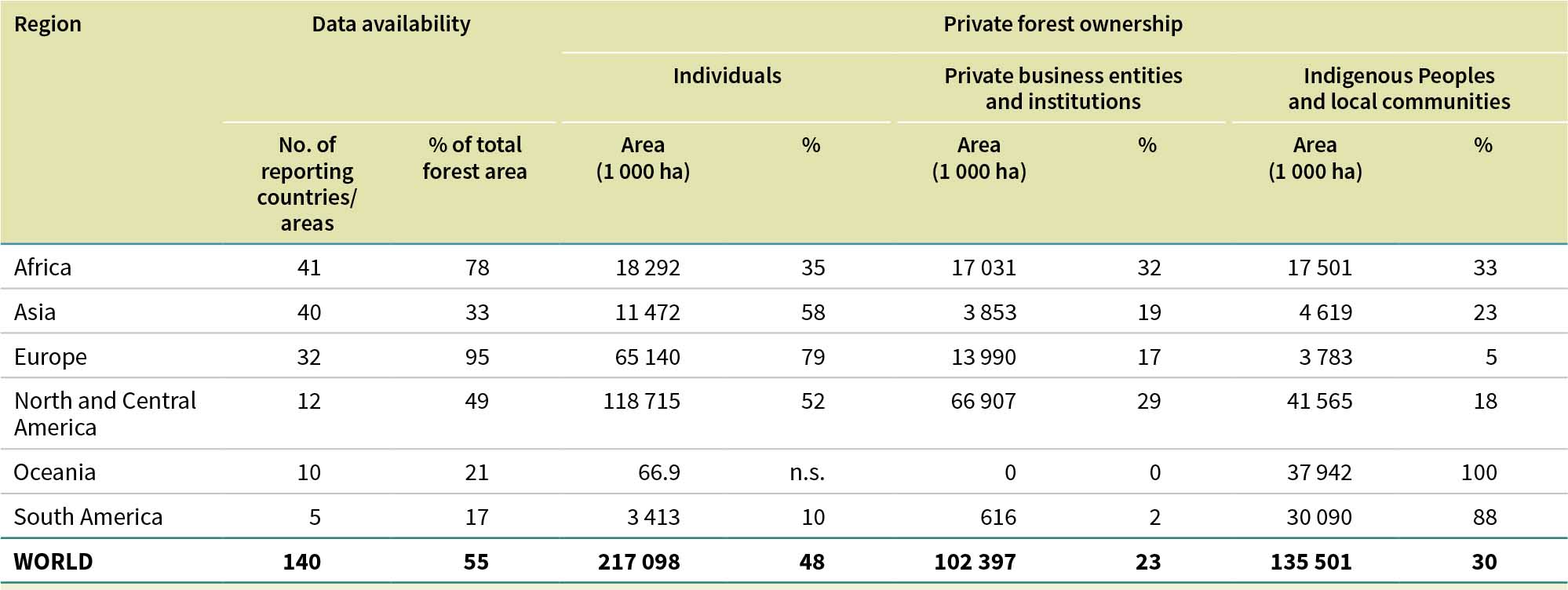
Although, as noted, insufficient data were available to derive regional findings for Oceania and South America, it is worth noting that Indigenous Peoples and local communities owned 100 percent of the private forest in Guyana (corresponding to 14 percent of the country’s forest area) in 2020, 91 percent in Ecuador (11 percent of the forest area) and 87 percent in Peru (37 percent of the forest area). Oceania, Niue, Papua New Guinea, Vanuatu and the Wallis and Futuna Islands reported that 100 percent of their forest areas was owned by Indigenous Peoples and local communities.
Indigenous Peoples and local communities owned 41.6 million ha in North and Central America (18 percent of the privately owned forest area) in 2020. If data reported by Canada on the area of forest owned by Indigenous Peoples and local communities are included (Canada did not report on all three subcategories of private ownership and therefore was not included in the global analysis), the share of forest owned by Indigenous Peoples and local communities in North and Central America increases to 49.3 million ha (19 percent of the private forest area).
The largest share of privately owned forest held by private business entities and institutions in 2020 was in Africa, at 32 percent, followed by North and Central America, at 29 percent.
FRA 2025 received complete time-series data on the area of forest in the three categories of private ownership from 131 countries and areas representing 52 percent of the world’s forests. Globally, the proportion of forest owned by individuals declined between 1990 and 2020, from 53 percent to 49 percent. The share of forest area owned by Indigenous Peoples and local communities also decreased slightly over the period, from 27 percent to 26 percent, and the area owned by private business entities and institutions increased from 20 percent to 24 percent (Figure 42).

The decrease in the share of forest area owned by individuals was particularly evident in North and Central America, where it dropped from 59 percent in 1990 to 52 percent in 2020; there was a slight decrease in Africa and Asia and the share was steady in Europe (at 79 percent). Insufficient data were available for South America and Oceania to derive statistically significant trends in those two regions.
The share of forest area owned by Indigenous Peoples and local communities decreased in North and Central America, from 19 percent in 1990 to 18 percent in 2020. It was steady in Africa and Asia, at 33 percent and 26 percent, respectively, and increased slightly in Europe, from 3 percent to 4 percent.
The global increase in the proportion of forests owned by private business entities and institutions was reflected in North and Central America, where it increased from 21 percent in 1990 to 29 percent in 2020. The share of forests owned by private business entities and institutions also increased in Africa over the period, from 30 percent to 32 percent, and in Asia, from 19 percent to 20 percent. The share of private forest owned by private business entities and institutions was stable in Europe between 1990 and 2020, at 18 percent.
FRA 2025 received information on the holders of management rights in public forests in 2020 from 182 countries and areas accounting for 94 percent of the global forest area.
Public administrations held 79 percent of management rights in publicly owned forests worldwide in 2020, private business entities and institutions held 16 percent, and Indigenous Peoples and local communities held 3 percent (Table 80). The remaining 2 percent was reported as other/unknown (mainly composed of mixed holders).
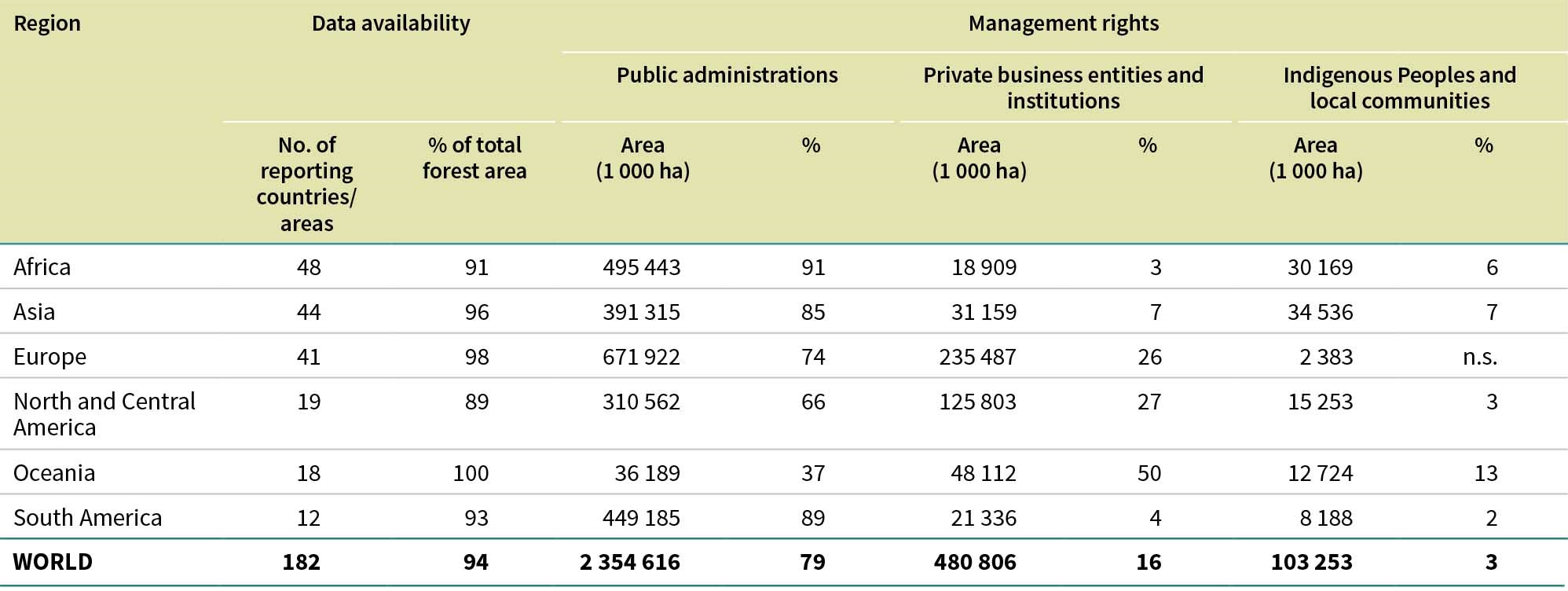
Public administrations were the predominant holders of management rights in publicly owned forests in all regions except Oceania, where they represented 37 percent of all such holders. The largest share of management rights in public forests held by public administrations was in Africa, at 91 percent, followed by South America, at 89 percent (Figure 43).
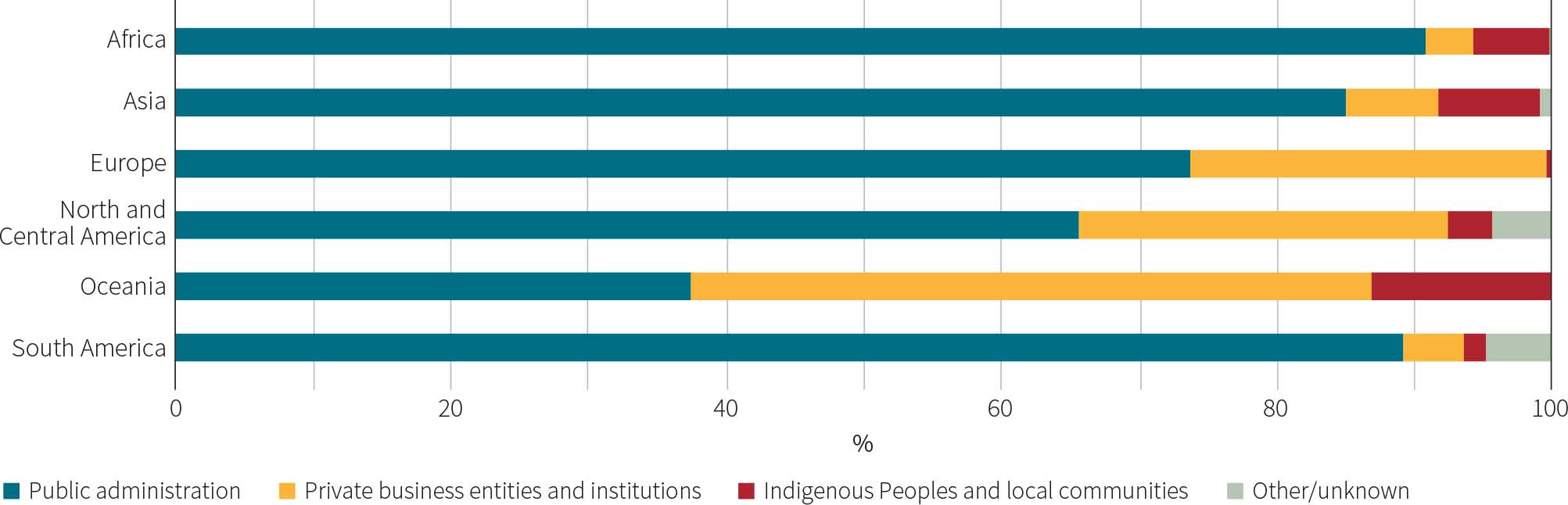
Private business entities and institutions held 50 percent of the management rights in publicly owned forests in Oceania in 2020, which was the highest share among the regions. The lowest share held by private business entities and institutions was in Africa, at 3 percent. Indigenous Peoples and local communities held 13 percent of management rights in publicly owned forests in Oceania in 2020, which was the largest share among the regions. Indigenous Peoples and local communities held management rights to about 2.38 million ha of publicly owned forest in Europe, which was 0.26 percent of the forest area in that region.
FRA 2025 received time-series data on the allocation of management rights in public forests from 170 countries and areas representing 87 percent of the global forest area. The proportion held by public administrations decreased globally from 94 percent in 1990 to 81 percent in 2020. The share held by private business entities and institutions increased from 4 percent to 15 percent over the period, and the share held by Indigenous Peoples and local communities increased from 2 percent to 3 percent (Figure 44).
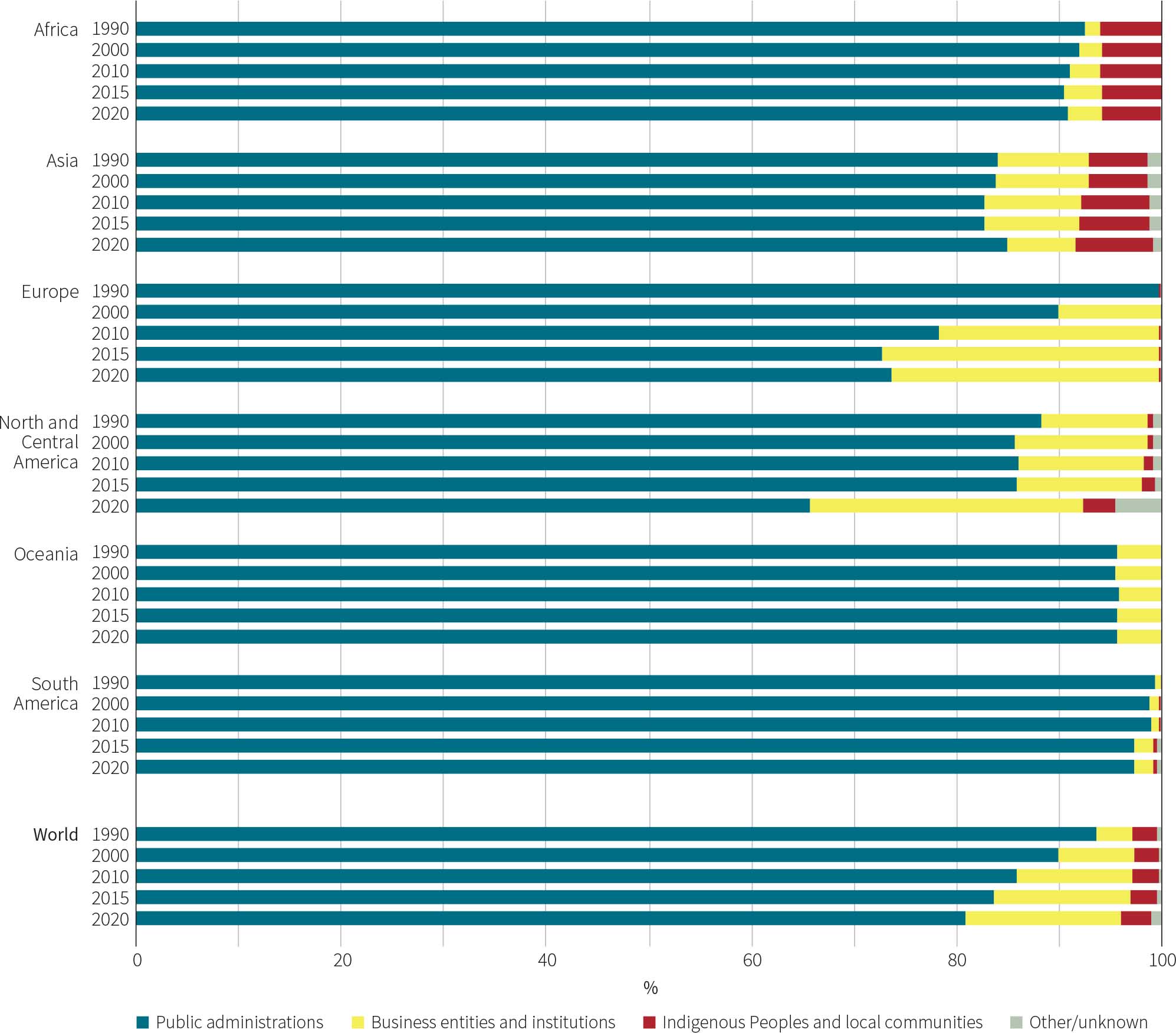
The global decrease in the proportion of management rights to publicly owned forest held by public administrations was reflected in all regions except Asia, where it increased from 84 percent in 1990 to 85 percent in 2020, and in Oceania, where it was steady at 96 percent. The decrease in the share of publicly owned forest managed by public administrations was most evident in Europe and North and Central America, where it dropped from 100 percent to 74 percent and from 88 percent to 66 percent, respectively, between 1990 and 2020.
The global increase in the proportion of management rights to publicly owned forest held by private business entities and institutions was reflected in all regions except Asia, where the share declined from 9 percent in 1990 to 7 percent in 2020, and Oceania, where it was steady, at 4 percent. The biggest increase in the share of management rights held by private business entities and institutions was in Europe, where it grew from zero in 1990 to 26 percent in 2020. This shift was due largely to the Russian Federation, where the area of publicly owned forest managed by the private sector increased from zero in 1990 to 235 million ha in 2020. The proportion of management rights to publicly owned forests held by private business entities and institutions also increased substantially in North and Central America, from 10 percent in 1990 to 27 percent in 2020. This was due mainly to data reported by Canada, where the area more than doubled, from 48.0 million ha in 1990 to 126 million ha in 2020.
The share of publicly owned forest managed by Indigenous Peoples and local communities increased most in North and Central America over the period, from 1 percent in 1990 to 3 percent in 2020. There was also a slight increase in the proportion of public forest managed by Indigenous Peoples and local communities in Asia, from 6 percent in 1990 to 7 percent in 2020. This was due mainly to Indonesia and Mongolia, where the area of public forest managed by Indigenous Peoples and local communities increased from zero in 1990 to 4.39 million ha in 2020 in Indonesia and from zero to 3.52 million ha in Mongolia. In the other regions, the proportion of publicly owned forest for which Indigenous Peoples and local communities held management rights was steady between 1990 and 2020.