1. Introduction

For nearly 80 years, the Food and Agriculture Organization of the United Nations (FAO) has, at the request of its Members, collected, analysed and disseminated information on the world’s forest resources through the Global Forest Resources Assessment (FRA).
Since 2005, the FRA has relied on data provided by a network of officially nominated national correspondents that is well-established today and covers 197 countries and areas. FRA reports are now produced every five years to provide up-to-date information on the world’s forests and how they are changing.
The scope and processes of FRAs reflect recent developments in international forest policy, such as the 2030 Agenda for Sustainable Development, the United Nations Strategic Plan for Forests 2017–2030 (UNSPF), the Paris Agreement on climate change, and the recently adopted Kunming–Montreal Global Biodiversity Framework. For example, efforts were made to exchange information with the national focal points for the United Nations Framework Convention on Climate Change (UNFCCC) and for Sustainable Development Goal (SDG) 15 (Box 1) and to enhance collaboration with the United Nations Forum on Forests on reporting on the Global Forest Goals, as set out in the UNSPF.
The 193 Member States of the United Nations adopted the 17 Sustainable Development Goals (SDGs) in September 2015 as part of the 2030 Agenda for Sustainable Development. These global goals are designed to steer the actions of the international community between 2016 and 2030. A comprehensive global indicator framework, consisting of 232 indicators, was established in March 2017 to monitor progress. Forests are crucial for achieving many of the SDGs, particularly SDG 15 (life on land), which highlights their importance for the sustainability of terrestrial ecosystems. FAO serves as the custodian agency for 21 indicators and contributes to another five. Three of these indicators are for SDG 15, with data on two (15.1.1 and 15.2.1) collected and reported through the Global Forest Resources Assessment (FRA) (see Figure A).

SDG indicator 15.1.1, “Forest area as a proportion of total land area”, is calculated by dividing the forest area reported by countries and areas in FRAs by their official land areas. Land-area data are collected from FAO Members through the annual FAO Questionnaire on Land Use, Irrigation and Agricultural Practices and are published in FAOSTAT.
SDG indicator 15.2.1, “Progress towards sustainable forest management”, is more complex to measure because no single quantifiable characteristic fully captures the multiple dimensions of sustainable forest management. FAO collaborated with partners to develop a reporting methodology, establishing five subindicators to monitor progress across the economic, social and environmental aspects of sustainable forest management (Figure B).

The environmental values of forests are assessed via three subindicators that measure change in forest area (“annual forest area change rate”), biomass stock in forests (“aboveground biomass in forest”), and efforts to protect biodiversity and other natural and cultural resources (“proportion of forest area within legally established protected areas”). The other two subindicators focus on the economic and social dimensions of sustainable forest management. The presence of forest management plans (as measured by the subindicator, “proportion of forest area with long-term forest management plans”) reflects a commitment to sustainability, and the area of certified forest (“forest area under independently verified forest management certification schemes”) indicates compliance with national or international management standards, verified by independent certification bodies.
Data for subindicators 1–4 are collected through the FRA country reporting process, and data for subindicator 5 are obtained from two global certification bodies, the Forest Stewardship Council and the Programme for the Endorsement of Forest Certification.
A dashboard with “traffic lights” is used to assess progress on each subindicator at the regional and global levels, indicating whether the conditions are improving (green), stable (amber) or deteriorating (red).
Detailed definitions and methodologies for each indicator and subindicator can be found in the SDG metadata repository.*
Annually since 2017, FAO has reported data to the United Nations Statistics Division for SDG indicators 15.1.1 and 15.2.1 at the global, regional and country levels. Among the subindicators, data on forest certification are updated annually; for the other indicators and subindicators, reports up to 2019 were based on data from FRA 2015, while reports for 2020–2025 relied on FRA 2020 data. From 2026, reports will be based on FRA 2025 data, with voluntary updates by countries as new information becomes available.
Annual reports and data on these indicators can be accessed through the FAO SDG Indicators Data Portal (FAO, n.d.).
In addition to compiling SDG indicators 15.1.1 and 15.2.1, the FRA team coordinates the compilation of indicator 15.4.2, which is designed to monitor progress on the conservation of mountain ecosystems (SDG target 15.4). This indicator is composed of two subindicators – 15.4.2a, “Mountain Green Cover Index”, for measuring the extent of, and changes in, green cover in mountain areas; and subindicator 15.4.2b, “proportion of degraded mountain land”, designed to monitor the extent of degraded mountain land as a result of land-cover change. This indicator is monitored using spatially explicit land-cover data following technical guidance and with the support of easy-to-use computation tools and eLearning courses developed by FAO and partners to support countries in reporting on this indicator.
Note: * The SDG indicators metadata repository is accessible at https://unstats.un.org/sdgs/metadata/.
Efforts were also made to streamline reporting for FRA 2025 with the aim of reducing the reporting burden on countries, minimizing duplication, making reporting more relevant, and, to the extent possible, increasing the quality, consistency and transparency of the reported data. If new data become available inside the five-year FRA reporting cycle, countries may now also provide voluntary updates of their reports (FAO, 2023a).
The online reporting platform implemented for FRA 2020 has been further developed to facilitate reporting and to increase the transparency and reliability of estimates and the accessibility and usability of data for end-users (Box 2). For the first time, FRA data are available via an application programming interface to allow automated data downloads and enhance collaboration and integration with other organizations and users.
The Global Forest Resources Assessment (FRA) Online Platform was implemented for FRA 2020* in response to an identified need for an online tool capable of facilitating reporting, review and transparency and improving the dissemination of results. Building on the success of reporting for FRA 2020, the online platform was further enhanced for FRA 2025. All data and metadata reported for FRA 2020 were pre-filled, and several functionalities – such as automated checks, the document repository and geospatial tools – were improved. Countries were enabled and encouraged to add hyperlinks to data sources and references.
The FRA Online Platform serves as a common reporting tool for other partners of the Collaborative Forest Resources Questionnaire,† especially for collecting data for pan-European reporting on indicators for sustainable forest management, in collaboration with Forest Europe and the United Nations Economic Commission for Europe. The platform also helps in monitoring progress towards Sustainable Development Goal 15 and other internationally agreed goals and targets. Access to the platform for data entry is exclusive to FRA national correspondents and their collaborators.
The FRA Online Platform is available in the six United Nations languages (Arabic, Chinese, English, French, Russian and Spanish). Its open-access dissemination module has the following functionalities: visualization of all data reported by individual countries; download capability for all individual reporting tables in CSV format; download capability for regional and subregional summary statistics in a non-proprietary spreadsheet format; and the capability for bulk downloads of all data. The platform had 17 000 users and 372 700 pageviews in 2024.
Notes: * FAO. 2020. Global Forest Resources Assessment 2020: Main report. Rome, FAO. † FAO, the International Tropical Timber Organization, Forest Europe, the United Nations Economic Commission for Europe, the Observatory of Central African Forests, and the countries of the Montréal Process.
Each FRA is independent of previous FRAs. When new and improved data become available, countries and areas may revise previously reported data to reflect the more accurate estimates; hence, data reported for different FRAs should not be compared.
The preparatory work for FRA 2025 began in 2021 with an internal evaluation of the FRA 2020 reporting process, followed by a user survey, the results of which assisted in shaping the scope and reporting content of FRA 2025. The scope and content were further refined in consultation with other teams in the FAO Forestry Division as well as with the FRA Advisory Group, partners of the Collaborative Forest Resources Questionnaire, and the FAO–United Nations Economic Commission for Europe Team of Specialists on Sustainable Forest Management. The Expert Consultation held in September 2022 provided important inputs for the finalization of the scope and reporting framework of FRA 2025 (Henderson Howat et al., 2022).
The reporting process was launched in February 2023 at the first workshop (for Caribbean countries, held in Bridgetown, Barbados) for national FRA correspondents. Thirteen more workshops were convened between March and December 2023 to support countries in compiling and finalizing the FRA 2025 country reports (Annex 1). The workshops also provided a forum in which national correspondents could share their experiences with colleagues from other countries.
Throughout the reporting phase, regional FRA focal points and reviewers were in regular contact with national correspondents and their teams to provide technical support on the reporting tables, the analysis and interpretation of national data, and the use of the online reporting platform. Once compiled, the country reports were submitted for technical review via the online platform. With the technical review, country reports underwent detailed checks to ensure completeness and the correct application of definitions and methodologies as well as internal consistency. Where needed, consistency was also checked against other published information sources. Around 30 experts from FAO and other international bodies contributed to the review process. A final validation phase was conducted to officially inform national heads of forestry of the contents of the report and to request their clearance for publication on a no-objection basis.
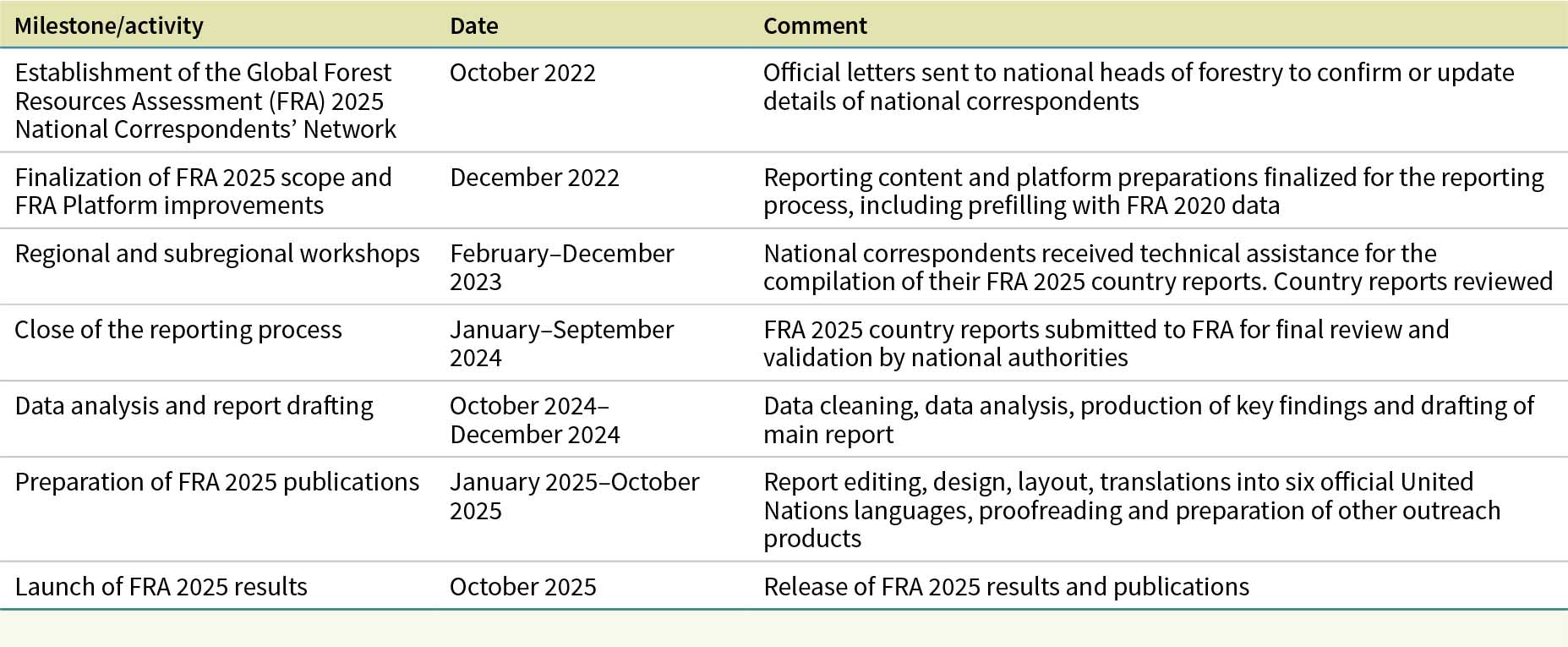
Table 1 summarizes the key milestones in the development of FRA 2025.
FRA 2025 examines the status of, and trends in, around 50 broad variables (under seven main topics – see below) in the period 1990–2025. The backbone of the assessment are data reported through standardized country reports, which were compiled by officially nominated national correspondents through the online platform, as described above.
Each report contains 22 reporting tables organized by the following seven topics: (1) forest extent, characteristics and changes; (2) growing stock, biomass and carbon; (3) forest designation and management; (4) forest ownership and management rights; (5) forest disturbances; (6) policies and legislation; and (7) non-wood forest products. For each reporting table, national correspondents were requested to provide full references for original data, describe the methodologies used for estimation, forecasting and reclassification, and document the assumptions made.
FRA 2025 includes a total of 236 countries and areas, based on the United Nations Statistics Division Standard country or area codes for statistical use (M49) (United Nations Statistics Division, n.d.). The following listed units are excluded:
Åland Islands (included under Finland)
Antarctica
Bouvet island
British Indian Ocean Territory
China, Hong Kong SAR (included under China)
China, Macao SAR (included under China)
Christmas Island
Cocos (Keeling) Islands
French Southern Territories
Heard Island and McDonald Islands
South Georgia and the South Sandwich Islands
United States Minor Outlying Islands.
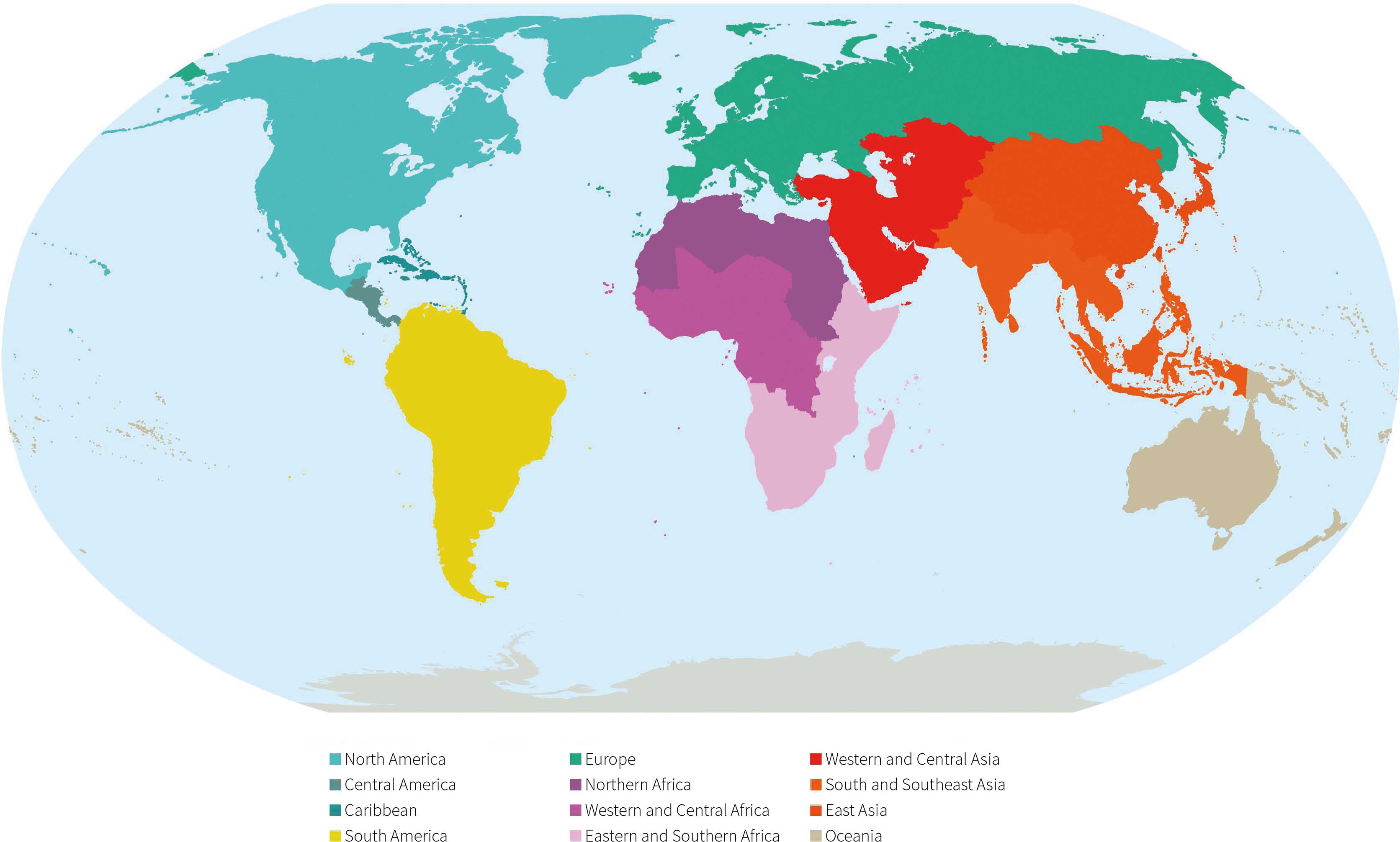
The regional and subregional groupings are the same as those used in previous FRAs (Figure 1).
Data submitted by countries through the online platform were stored in a database for easy retrieval and analysis. Forty-two desk studies, representing 1.6 percent of the total forest area in 2025, were prepared for countries and areas that did not submit reports.
National data were aggregated to derive subregional, regional and global estimates. Trend estimates generally only include countries that reported complete time series (i.e. for 1990, 2000, 2010, 2015, 2020 and 2025) (although, in some cases, gap-filling was performed for missing values to obtain complete time series for estimates of trends). It is not always possible, therefore, to reproduce the estimates of global, regional and subregional aggregates presented in this report by aggregating the reported country data. Because of the vast size of forest resources in the Russian Federation, data for the rest of Europe are presented separately in some tables.
This report presents the findings of the data analysis, comprising the status of, and main trends in, each variable. Note that numbers given in the text, tables and figures may not sum to the totals indicated and percentages may not tally to 100 due to rounding. Values are generally rounded to three significant figures. Very small numbers and percentages that would otherwise round to zero are shown as “not significant” to indicate that they are non-zero values.
Not all countries and areas reported on all parameters mentioned herein. Annex 2 summarizes the data (by variable) at the global and regional levels, and Annex 3 presents data on forest area and forest characteristics for countries and areas.
In addition to this main report, the outputs of FRA 2025 comprise:
a digital report;
an interactive story on the main findings of FRA 2025;
an interactive database with all data and metadata reported to FRA 2025;
236 country and area reports in PDF format;
three FRA working papers – on the country reporting process and voluntary update (FAO, 2023a), the FRA 2025 terms and definitions (FAO, 2023b), and the FRA 2025 guidelines and specifications (FAO, 2023c); and
scientific papers and special studies using FRA 2025 data produced in collaboration with partner institutions and international experts (in preparation).5
