

Given that land degradation is already widespread across diverse landscapes and farming systems, the challenge now lies in how to respond effectively across landholding scales and degradation gradients. As discussed in Chapter 2, unsustainable intensification and rising trends in land abandonment are a warning sign: the viability of agricultural production is at stake. Yet degradation is not uniform. Even within a single farm, land parcels may vary in condition, requiring tailored responses that reflect both the severity of degradation and the potential for recovery.
Land degradation often stems from a misalignment between private incentives – both economic and sociocultural – and the public value of ecosystem services. This disconnect has led to scale-dependent pathways of degradation (Box 18). As discussed in Chapter 2, most of the global cost of land degradation is borne by the broader society due to the loss of ecosystem services, including biodiversity, regulating services and carbon sequestration. Addressing the misalignment requires action across a spectrum of land conditions. On land currently used for agriculture – including permanent meadows and pastures, arable land, and permanent crops – degradation can be masked by input intensification, where productivity can still be restored through improved management practices; yet such practices have diminishing returns in places that are already operating close to their biophysical yield potential. In contrast, severely degraded or abandoned lands demand more transformative approaches, such as land-use change and ecological rehabilitation.
Box 18Context matters when trying to reverse scale-dependent pathways of degradation
All agricultural land today exhibits some degree of degradation, and this should be considered by policymakers. However, degradation is shaped by historically diverse trajectories of agricultural development, production systems, and varying levels of intensification across regions.
Two contrasting extremes have emerged for degradation on croplands. At one end, in systems with a history of intensification, degradation tends to be largely masked by further increasing input use, making it more difficult to detect despite its severity. These systems are dominated by medium and large landholdings, with farms larger than 1 000 ha controlling most of the land.
At the other end, many agricultural systems have not benefited from intensification, particularly in large parts of Africa where low-input, low-output smallholder farms dominate. Productivity has remained stagnant; cropland degradation may occur, but it is not the main obstacle to reducing yield gaps.28, 33 The widespread low-input, low-output nature of smallholder farming in these areas presents a major challenge. Past historical intensification pathways are an option for closing yield gaps; however, limiting land degradation through more sustainable means is needed for long-term viability.
Between these two extremes lie agricultural systems that have experienced intensification relatively recently. These systems – predominantly in Asia, the region home to the smallest farm sizes globally – have seen increased input use starting in the middle of the twentieth century, but often without proportional gains in productivity. This has led to the accumulation of more severe land degradation impacts than in non-intensified systems, but without the productivity gains observed in areas with high levels of intensification. Input use thus only partially masks the effects of land degradation. It has led to heterogeneity in yield gaps, which are sizeable in some areas (though generally still lower than in non-intensified systems), and low in others.
Furthermore, in countries where degradation is occurring in rangelands and forests, additional layers of contextual information will be needed in order to design regulations and incentive-based schemes. In rangelands, tenure and property rights are important factors determining what is viable and effective. Similarly, for forest areas, the drivers of land-use change and who is involved must be considered.
Landholders along these various pathways may co-exist within a country, forming a specific mix in terms of land size distribution, resources and production systems. Therefore, policymakers will need to take into account all these factors when designing regulations or incentive-based schemes.
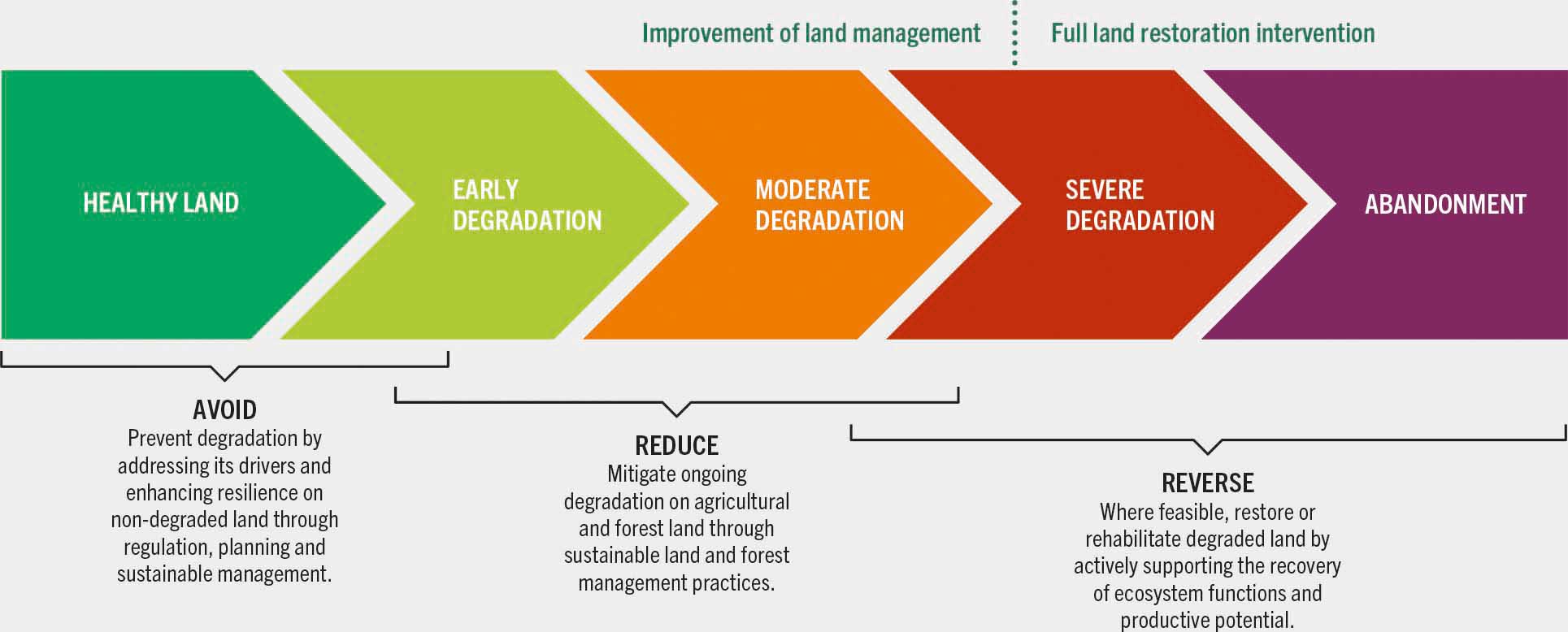
To guide such efforts, the UNCCD promotes a hierarchy of responses – avoid > reduce > reverse – which together form the foundation of land degradation neutrality strategies.32 This hierarchy reflects both the urgency and the cost-effectiveness of different interventions. Avoiding degradation on healthy, productive lands is the most efficient strategy, as it prevents the loss of ecosystem services before damage occurs. Where degradation is already underway, efforts must focus on reducing or halting its progression through improved land management. In cases where land has been severely degraded or abandoned, more transformative measures are needed to reverse damage – often involving land-use change, ecological restoration and long-term investment. In these cases, lands have exceeded thresholds for viable use without intervention.
Figure 24 illustrates how the avoid–reduce–reverse framework aligns with the condition of land, distinguishing between agricultural land where degradation can still be managed – albeit at increasing cost as degradation progresses – and land that has crossed viability thresholds and requires a fundamental reset in management strategy. This conceptual progression helps clarify where incremental improvements are sufficient and where more systemic change is needed.
Figure 24 Strategic responses across land degradation stages: from improving land management to full-scale land restoration
While the avoid–reduce–reverse framework provides a useful foundation, effective implementation also requires differentiated strategies that consider the degree of land degradation (e.g. whether sustainable land management or land-use and land-cover change is needed) and reflect the diversity of land users and production systems. Designing tailored approaches also requires an understanding of various types of policy instruments along with their management and monitoring burdens, as well as financial needs. These are discussed in detail in the next section.


